
Introduction
On any active job site, a hard hat's color communicates more than most workers realize — it signals role, authority level, and trade qualifications at a glance. With construction accounting for 1,032 workplace fatalities in 2024, being able to instantly identify who does what isn't just organizational convenience — it's a frontline safety control.
While OSHA does not mandate specific color assignments, a widely followed color code system has developed across construction, electrical, and industrial sectors. Understanding this system improves both safety and site coordination, allowing supervisors to identify workers by trade or authority at a glance—especially in noisy, fast-moving environments. This guide covers what each color means, why it matters, relevant ANSI/OSHA standards, and how to put an effective system in place on your site.
Key Takeaways
- Hard hat colors identify a worker's role, authority level, or visitor status—not randomly assigned
- No federal law mandates specific color meanings, but industry best practices are widely consistent across U.S. sites
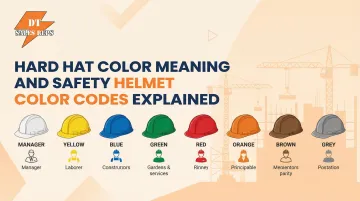
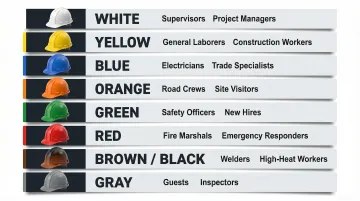
- Common assignments: white for supervisors, yellow for general laborers, blue for electricians, orange for visitors, and green for safety officers or new hires
- ANSI/ISEA Z89.1 governs hard hat performance standards, not color assignments, though OSHA compliance is still required
- Understanding the color system helps supervisors make faster, safer decisions
What Are Hard Hat Color Codes?
Hard hat color codes are a system where specific helmet colors are assigned to workers based on their job function, seniority, or access level on a construction or industrial site. These codes function as a silent communication tool: a glance at a helmet tells supervisors who is a visitor, who is a licensed electrician, and who is the site safety officer without needing a verbal exchange.
Key characteristics:
- Set by individual companies or general contractors, not a federal mandate
- Followed consistently enough across U.S. job sites that workers recognize the system project to project
- Flexible enough for organizations to adjust, though straying too far from common practice reduces effectiveness
That consistency is what gives color codes their real value — the same basic system travels from site to site, so workers and supervisors don't need a briefing every time they change projects.
Why Hard Hat Color Codes Matter for Job Site Safety
Color codes deliver practical safety benefits that directly impact incident prevention and emergency response. In 2022, construction workers accounted for 19.9% of all on-the-job fatal injuries despite representing only 7.5% of employment, with a fatal injury rate of 9.6 per 100,000 FTEs—more than double the 3.9 rate for all industries.
On a fast-moving job site, seconds matter. Color-coded hard hats give crews and supervisors a shared visual language that works even when noise, distance, or urgency makes verbal communication impossible.
Instant Role Identification in Critical Situations
- Supervisors identify workers by trade or authority without needing verbal confirmation
- During emergencies, red or green hard hats quickly identify who holds emergency response authority
- Falls to lower level accounted for 36.4% of construction fatalities in 2022—recognizing rescue-trained personnel faster can directly reduce response time
Efficiency and Access Control
Color coding also tightens site control in ways that radio check-ins and verbal instructions can't match.
- Foremen can spot who is in restricted areas (for example, blue-helmeted electricians in a high-voltage zone)
- Reduce unauthorized access to hazardous work zones
- Track where specific crews are working at any moment without radio check-ins
- Keep projects running smoothly by ensuring the right workers are in the right places
Compliance and Accountability
- Visual confirmation that qualified workers are performing specialized tasks
- Easier documentation of who was present in specific areas during incidents
- Supports contractor coordination when multiple trades work simultaneously
Hard Hat Color Codes Explained: What Each Color Means
While individual companies may adjust assignments, the following color meanings reflect the most commonly used conventions across U.S. construction, electrical, and industrial job sites.
White Hard Hats
Worn by: Project managers, site supervisors, engineers, architects, safety directors
White hard hats designate decision-makers and authority figures on a job site. These are the individuals with oversight responsibility, budget authority, and the power to stop work for safety concerns.
Some companies further distinguish within white using stripe systems:
- One stripe = site engineer
- Two stripes = supervisor
- Three stripes = project manager
Yellow Hard Hats
Worn by: General laborers, earthmoving equipment operators, construction workers
Yellow is the most common hard hat on any site. It's assigned to workers performing hands-on build tasks, and it's often the default when no specific role is assigned. That makes it the universal "worker" designation across most U.S. sites.
Blue Hard Hats
Worn by: Electricians, carpenters, technical advisors, trade specialists
Blue hard hats identify skilled trade workers with specialized credentials. For electrical contractors, blue lets supervisors spot credentialed workers in areas with live or high-voltage equipment. That visual distinction matters when work involves energized circuits.
Note for electrical contractors: Blue identifies the trade, but the hard hat itself must also meet Class E (electrical) protection standards under ANSI Z89.1 for work involving high-voltage hazards.
Orange Hard Hats
Worn by: Road crews, lifting operatives, traffic marshals, site visitors
Orange's high-visibility properties make it appropriate for workers near moving vehicles or heavy equipment. Roadway incidents involving a vehicle accounted for 13.9% of construction fatalities in 2022, making high-visibility marking critical for traffic-exposed crews.
Some sites use orange specifically for visitors, while others use gray — always confirm the local convention.
Green Hard Hats
Worn by: Safety officers, environmental inspectors, new hires, trainees
Green serves a dual purpose on most sites:
- Safety officers and inspectors, who need to be easy to locate during incidents
- New hires and trainees, signaling that these workers may be unfamiliar with site hazards
This dual use requires clear site-specific communication about which green-hat wearers are authority figures versus learners.
Red Hard Hats
Worn by: Fire marshals, emergency responders, safety personnel
Red hard hats are associated with emergency response roles in most U.S. systems. In an emergency, red helmets should be immediately recognizable — workers trained to coordinate evacuation, fire suppression, or medical response.
International note: In the UK convention, red is used for plant operators. Always confirm the local convention when working across borders.
Brown and Black Hard Hats
Brown is conventionally used by welders and workers in high-heat applications. Black is associated with site supervisors, forepersons, or high-voltage electricians in some systems.
Both colors are less standardized than white, yellow, or blue. Always confirm site-specific assignments rather than assuming a role from color alone.
Gray Hard Hats
Gray is the standard "guest" designation on most U.S. job sites. It signals to workers that the wearer — typically a visitor, inspector, or client — may be unfamiliar with site hazards and should be accompanied or monitored.
OSHA, ANSI Standards, and Hard Hat Classifications
What OSHA Requires (and Doesn't)
OSHA requires head protection in designated hazard zones but does NOT specify which color must be used for which role. Color assignments are a company-level decision.
Regulatory requirements:
- 29 CFR 1926.100 (Construction): Requires protective helmets where there is danger of head injury from impact, falling objects, or electrical shock
- 29 CFR 1910.135 (General Industry): Requires helmets designed to reduce electrical shock hazard near exposed conductors
- One exception: High-visibility requirements (ANSI/ISEA 107) for workers near traffic govern visibility level, not color meaning
ANSI/ISEA Z89.1 Classifications
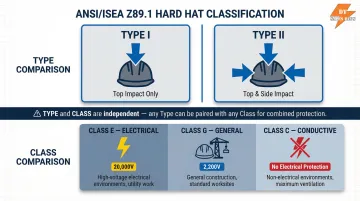
The ANSI/ISEA Z89.1 standard governs hard hat performance, not color. Two independent axes — Type (impact) and Class (electrical) — determine what protection a helmet actually provides.
Type Classifications (Impact Protection):
| Type | Protection Scope | Best For |
|---|---|---|
| Type I | Top-impact protection only | General construction with overhead hazards |
| Type II | Top and lateral impact protection | Steel erection, confined spaces, environments with side-impact risks |
Type covers the direction of impact a helmet can handle. Class covers whether it can protect against electrical exposure — and the two ratings combine independently on any given helmet.
Class Classifications (Electrical Protection):
| Class | Voltage Protection | Typical Use |
|---|---|---|
| Class E (Electrical) | Proof-tested to 20,000 volts | Electricians, utility workers, high-voltage environments |
| Class G (General) | Proof-tested to 2,200 volts | General construction with low-voltage exposure |
| Class C (Conductive) | No electrical protection | Vented hard hats where no electrical hazards exist |
Electrical contractors working in high-voltage environments need Class E as a minimum — regardless of helmet color. A blue hard hat without a Class E rating does not provide adequate protection near energized circuits.
Hard Hat Lifespan and Replacement
OSHA advises retiring head protection immediately after significant impact, even if no visible damage is present. Manufacturers provide specific replacement intervals:
Replacement guidelines:
- Thermoplastic shells: 3–5 years from manufacture date
- Fiberglass shells: 5–8 years from manufacture date
- Suspension systems: Replace every 12 months minimum
- After any impact: Replace immediately, regardless of visible damage
Inspection triggers for immediate replacement:
- Faded color or chalky appearance
- Stiff or brittle feel
- Cracks, dents, or penetration
- Exposure to chemicals, extreme heat, or UV degradation
How to Set Up a Hard Hat Color Code System at Your Job Site
Step 1: Audit Roles and Assign Colors
Before implementing a color system, audit which trades and roles are on-site. Avoid overcomplicating with too many colors—stick to 5-7 distinct assignments.
Sample assignment matrix:
- White: Site supervisors, project managers, engineers
- Yellow: General laborers, operators
- Blue: Electricians, carpenters, technical trades
- Orange: Traffic control, road crews
- Green: Safety officers, new hires
- Gray: Visitors, inspectors
Step 2: Ensure Consistency from Day One
A color system that isn't universally enforced breaks down fast—especially when subcontractors rotate on and off site.
Implementation checklist:
- Post a visible color code chart at all site entry points
- Include the color code in new-worker orientation
- Add color code requirements to subcontractor agreements
- Distribute the chart to all foremen and supervisors
- Require compliance before site access is granted
Step 3: Avoid Common Mistakes
Mistakes that undermine color coding:
- Assigning colors based only on availability rather than role clarity
- Failing to communicate the system to subcontractors who arrive mid-project
- Not updating the code when new trades join
- Allowing workers to swap helmets or wear incorrect colors
- Not enforcing the system for short-term visitors
Each of these gaps creates the same risk: someone in the wrong role gets treated as a different authority level on-site, and response time in an emergency slows as a result.
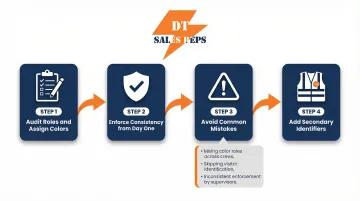
Step 4: Use Secondary Identifiers
Pair helmet colors with secondary cues for reinforcement. For example, Skanska's EHS manual requires spotters to be "readily identifiable, such as with a specific color hard hat, vest, etc." and mandates hard hat stickers for trained spotters.
Secondary identifier options:
- High-visibility vests with role labels
- Hard hat decals indicating certifications
- Reflective tape for night work
- Printed role titles on helmets
Sourcing Hard Hats for Your System
DT Sales Reps supplies ANSI-rated hard hats across a full range of colors, sourced as part of its jobsite essentials catalog for distributors and contractors. Whether you're outfitting a single crew or multiple sites, contact DT Sales Reps at 281-900-1506 or DavidS@DTTexas.com for availability and bulk pricing.
Frequently Asked Questions
What do the colors of hard hats mean?
Hard hat colors signal a worker's role on a job site—white for supervisors/management, yellow for general laborers, blue for electricians and technical trades, orange for road crews or visitors, green for safety officers or new hires. While conventions vary by company, this framework is widely followed across U.S. construction sites.
What are the 7 safety colors?
ANSI Z535 defines seven standard safety colors for hazard communication: red (danger), orange (warning), yellow (caution), green (safety/first aid), blue (notice), purple (radiation), and black/white (general information). These are distinct from hard hat color codes, which serve a separate purpose — role identification on the job site.
Are hard hat color codes required by OSHA?
No. OSHA does not mandate specific color meanings for hard hats—companies are free to set their own systems. The only color-related requirement involves high-visibility standards (ANSI/ISEA 107) for workers near traffic or moving equipment, which governs visibility level rather than role designation.
What color hard hat do electricians wear?
Blue is the most widely used color for electricians and electrical trade workers on U.S. job sites. The hard hat itself must also meet Class E (electrical) protection standards under ANSI Z89.1 for work involving high-voltage hazards. Color alone does not provide electrical protection.
When should a hard hat be replaced?
Replace thermoplastic shells every 3–5 years and fiberglass shells every 5–8 years from the manufacture date. Replace any hard hat involved in a significant impact immediately, even if no damage is visible. Suspension systems should be replaced every 12 months minimum.