Introduction
Outdoor electrical cable failures don't announce themselves—they accumulate. UV radiation slowly cracks PVC jackets that weren't rated for sunlight. Moisture seeps into improperly sealed conduit runs, degrading insulation from the inside out. Direct-burial cable without adequate depth protection gets crushed by soil compression or severed by landscaping equipment. Each scenario leads to the same result: failed inspections, emergency rework, project delays, and potential liability exposure.
For construction companies, electrical contractors, and OSP crews, outdoor cable selection directly shapes project timelines, compliance outcomes, and long-term reliability. Using standard indoor wire in outdoor applications violates NEC requirements and creates immediate safety hazards.
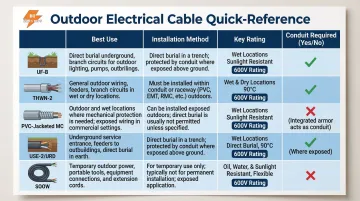
This guide covers the five most widely specified outdoor electrical cables—UF-B, THWN-2, PVC-Jacketed MC Cable, USE-2/URD Cable, and SOOW Portable Cord—including key specifications, best use cases, and what to verify when sourcing them for your next project.
Key Takeaways
- Outdoor cables require UV resistance, moisture ingress protection, and temperature tolerance that standard indoor wire cannot provide
- UF-B, THWN-2, PVC-Jacketed MC, USE-2/URD, and SOOW each serve distinct installation scenarios based on burial method and environmental exposure
- The right choice hinges on installation method, exposure conditions (wet, high-temp, or industrial), and load requirements
- NEC compliance varies by jurisdiction—verify burial depth, conduit requirements, and insulation ratings before ordering
- DT Sales Reps stocks the full range of cable types alongside conduit, pull boxes, and jobsite essentials—keeping specs consistent and projects on schedule
Why Outdoor Electrical Cable Is Different from Indoor Wire
Outdoor electrical cables are engineered systems, not simply indoor cables with thicker jackets. They must simultaneously withstand UV radiation, moisture intrusion, soil chemistry, temperature extremes, and physical impact—environmental stresses that would destroy standard indoor wiring within months.
Core Outdoor-Rated Properties
UV-Resistant Outer Sheath
Outdoor cables use polyethylene (PE) or cross-linked polyethylene (XLPE) jackets instead of standard PVC. UV stabilizers in these materials prevent the jacket from becoming brittle and cracking under prolonged sun exposure. Cables without a "Sunlight Resistant" marking will fail prematurely when exposed to direct sunlight or prolonged weather exposure.
Moisture-Resistant Insulation
NEC 300.9 classifies the interior of outdoor raceways as wet locations, requiring all conductors to carry explicit wet-location ratings. This prevents water ingress that causes short circuits and ground faults. Standard indoor NM-B (Romex) cable lacks this protection and is explicitly prohibited in wet locations per NEC 334.12(B)(4).
Thermal Stability
Outdoor cables must handle temperature swings from below freezing to extreme heat. THWN-2 conductors are rated for 90°C in wet locations — an upgrade from older THWN wire limited to 75°C. USE-2 cable with XLPE insulation maintains performance across a broader temperature range than PVC-jacketed alternatives.
Mechanical Durability
Direct-burial cables must resist soil compression and impact from landscaping equipment. Armored options like PVC-jacketed MC cable add an interlocked aluminum armor layer for crush resistance in high-traffic areas, exposed overhead runs, or rocky soil installations.
NEC-Defined Ratings and Markings
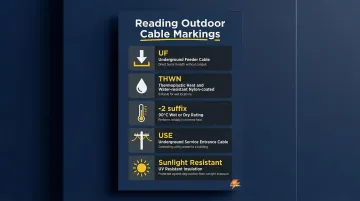
Those physical properties translate directly into the markings stamped on every cable jacket. Each marking is a code requirement — not a suggestion — that inspectors will verify during project walkthroughs.
| Marking | Cable Type | What It Means |
|---|---|---|
| UF | Underground Feeder | Rated for direct burial without conduit |
| THWN | Thermoplastic, Heat & Water-resistant, Nylon-coated | Approved for wet location use in conduit |
| -2 suffix | THWN-2, USE-2 | Confirms 90°C wet-location rating |
| USE | Underground Service Entrance | Designed for high-amperage underground feeders |
| Sunlight Resistant | Various | Passed UL ultraviolet exposure testing |
The 5 Best Outdoor Electrical Cables for Every Application
These five cable types represent the most widely specified and code-accepted options for outdoor electrical installations across residential, commercial, and industrial projects.
UF-B (Underground Feeder) Cable
UF-B is a PVC-jacketed, moisture-resistant cable designed specifically for direct burial without conduit. It's the standard choice for residential outdoor circuits, landscape lighting, detached garage feeds, and irrigation system power runs.
The solid, bonded jacket construction provides mechanical protection against soil compression and moisture intrusion. UF-B is rated for wet locations and sunlight resistance, and complies with NEC requirements for direct burial at 24-inch depth (12 inches with GFCI protection for residential 120V/20A circuits). The "-B" designation indicates 90°C-rated insulation, though NEC 340.80 limits ampacity calculations to the 60°C column.
| Specification | Details |
|---|---|
| Best Use | Direct burial for outdoor circuits, landscape lighting, detached garages, irrigation systems |
| Key Specs | 600V rating, 14 AWG to 2 AWG, moisture- and sunlight-resistant PVC jacket |
| Installation Method | Direct burial without conduit; NEC Table 300.5 depth requirements apply |
Key Restrictions: NEC 340.12 prohibits UF-B as service-entrance cable, in commercial garages, or hazardous locations. Where UF-B emerges from the ground, it requires protection by rigid metal conduit (RMC) or Schedule 80 PVC due to physical damage exposure.
THWN-2 Wire (in Conduit)
THWN-2 is a single-conductor thermoplastic wire with a nylon outer jacket, rated for wet and dry locations up to 90°C. It's the standard pull-wire choice for conduit-based outdoor electrical runs in commercial and residential installations.
The "-2" designation confirms a 90°C wet-location rating, an upgrade over older THWN wire limited to 75°C in wet conditions. That higher rating delivers more favorable ampacity derating when conduits carry multiple conductors or face high ambient temperatures. THWN-2 is compatible with all outdoor conduit types including EMT, PVC, and rigid metal conduit.
| Specification | Details |
|---|---|
| Best Use | Outdoor conduit runs for service panels, HVAC equipment, outdoor outlets, commercial builds |
| Key Specs | 600V rating, 90°C wet/dry, 14 AWG to 1000 kcmil, nylon-jacketed insulation |
| Installation Method | Must be installed in conduit (EMT, PVC, or rigid); not rated for direct burial alone |
Common Mistake: Using THHN-only wire (rated for dry locations) in outdoor conduit violates NEC 300.9. Always verify the cable jacket carries the THWN or THWN-2 marking for wet-location approval. Many modern conductors are dual-rated THHN/THWN-2, but you must confirm the jacket markings before installation.
PVC-Jacketed MC (Metal Clad) Cable
MC Cable with a PVC outer jacket combines interlocked metallic armor with a waterproof, UV-resistant PVC sheath. This construction makes it ideal for exposed outdoor runs, wet locations, and direct burial applications requiring physical protection.
The armor layer provides crush and impact resistance that standard cable types cannot match, protecting conductors in high-traffic areas, exposed overhead runs, or rocky soil direct burial. Standard MC cable without the PVC jacket is prohibited in wet locations per NEC 330.12, so always verify the specific UL 1569 listing for sunlight resistance and wet-location use.
| Specification | Details |
|---|---|
| Best Use | Exposed outdoor wiring, direct burial in mechanically demanding environments, commercial and industrial outdoor installations |
| Key Specs | 600V, interlocked aluminum armor with PVC jacket, multiple conductor configurations |
| Installation Method | Can be run exposed, in conduit, or direct buried when specifically listed for direct burial |
Labor Advantage: PVC-jacketed MC eliminates the need to install conduit before pulling individual wires, cutting labor costs on commercial outdoor runs while maintaining superior physical protection.
USE-2 / URD Cable
USE-2 (Underground Service Entrance) and URD (Underground Residential Distribution) cables are designed for high-amperage underground feeders connecting utility services, subpanels, outbuildings, and distribution points. They commonly use aluminum conductors for cost savings on large-gauge runs.
XLPE insulation rated for 90°C wet locations provides superior moisture and thermal resistance compared to PVC jackets. Large conductor sizes (often aluminum) make USE-2/URD highly cost-effective for long underground runs between structures. Aluminum conductors deliver 75-80% material cost savings compared to copper and weigh 50% less — a meaningful advantage on large-ampacity installations where material costs dominate.
| Specification | Details |
|---|---|
| Best Use | Underground service entrance, subpanel feeds, utility distribution runs between buildings |
| Key Specs | 600V, XLPE insulation, 90°C wet rating, large AWG sizes; commonly aluminum conductor |
| Installation Method | Direct burial rated; verify local NEC burial depth requirements for service entrance conductors |
Installation Restriction: NEC 338.12 prohibits Type USE cable for interior wiring. It must terminate at an exterior enclosure or immediately upon entering a building.
SOOW Portable Power Cable
SOOW is a flexible, oil-resistant, and water-resistant portable cord designed for outdoor equipment, tools, temporary power distribution, and generator connections where flexibility and durability are both essential.
The thermoset rubber jacket (EPDM insulation with CPE outer jacket) is oil-resistant, sunlight-resistant, and rated for -40°C to 90°C. This construction handles repeated bending, mechanical stress, and wet conditions that would crack PVC-jacketed cables. SOOW meets OSHA 1926.405 requirements for "extra-hard usage" on construction sites.
| Specification | Details |
|---|---|
| Best Use | Construction site power, portable equipment, generator connections, temporary outdoor power |
| Key Specs | 600V, flexible stranded copper conductors, EPDM rubber jacket, cold-weather and sunlight resistant |
| Installation Method | Portable use only; not rated for permanent installation or direct burial |
NEC Violation: NEC 400.12 explicitly prohibits using flexible cords as a substitute for fixed wiring. SOOW cannot be run through walls, attached to building surfaces, concealed behind walls, or buried underground. Restrict its use strictly to temporary construction power and flexible equipment drops.
How We Selected the Best Outdoor Electrical Cables
These five cable types were selected based on a rigorous evaluation framework: NEC listing and wet/outdoor ratings, availability across standard conductor sizes, suitability for multiple installation methods, and frequency of specification by electrical contractors in commercial and residential projects.
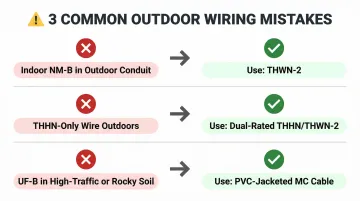
Common Specification Mistakes
Using Indoor-Rated Wire Outdoors: Running indoor NM-B (Romex) inside outdoor PVC conduit violates NEC 334.12(B)(4) and 300.9. The interior of outdoor raceways is legally classified as a wet location, requiring wet-rated conductors like THWN-2.
Specifying THHN Without Confirming THWN-2: THHN is rated for dry locations only. For outdoor conduit runs, verify the cable carries a THWN or THWN-2 rating for wet-location approval. Many modern wires are dual-rated THHN/THWN-2, but you must check the jacket markings.
Choosing UF-B for Applications Requiring Armor: While UF-B is excellent for standard direct burial, it lacks the crush resistance needed in high-traffic areas, exposed overhead runs, or rocky soil installations. PVC-jacketed MC cable provides superior physical protection in these scenarios.
The Sourcing Factor
Even the most accurate specification falls apart if materials aren't on-site when you need them. DT Sales Reps supplies distributors and contractors with a comprehensive inventory of cable and conduit products, keeping projects on schedule and within budget.
Sourcing from a single supplier means fewer coordination delays and better component compatibility. DT Sales Reps carries:
- HDPE conduit and PVC pipe
- Microduct and pull boxes
- Outdoor-rated cable across standard conductor sizes
Conclusion
Outdoor electrical cable selection is an application-specific decision. No single cable type works universally across all scenarios. Matching cable type to installation method (direct burial, conduit, or exposed), environmental exposure (wet, high-temperature, or industrial), and load requirements (gauge, voltage rating, and ampacity) forms the foundation of a safe, code-compliant outdoor installation.
Before finalizing material orders, verify cable markings, burial depth requirements, and conduit specifications against local NEC amendments. Jurisdictions often impose stricter requirements than the base code, and inspectors will enforce these standards during project walkthroughs.
Getting the right cable and conduit to the jobsite — on time and within spec — starts with the right supplier. DT Sales Reps stocks HDPE conduit, PVC, cable, pull boxes, and jobsite essentials for electrical and OSP contractors across commercial and infrastructure projects.
Contact DT Sales Reps at 281-900-1506 or DavidS@DTTexas.com to discuss your outdoor cable and conduit requirements.
Frequently Asked Questions
What electrical wire is best for outdoors?
The best outdoor wire depends on installation method. UF-B is ideal for direct burial without conduit, THWN-2 for conduit runs, and SOOW for portable and flexible outdoor applications. All must carry outdoor or wet-location ratings per NEC requirements.
Can I use THHN wire for outdoor electrical installations?
THHN is rated for dry locations only. For outdoor use in conduit, wire must carry a THWN or THWN-2 rating indicating wet-location approval. Many wires are dual-rated THHN/THWN-2, so verify the cable's jacket markings before installation.
What is the difference between UF-B cable and direct burial cable?
UF-B is a specific NEC-listed cable type designed for direct burial under Article 340. "Direct burial cable" is a general term that can include UF-B, USE-2, or listed MC cable—any cable specifically rated for underground installation without conduit.
Does outdoor electrical wire need to be in conduit?
It depends on the cable type. UF-B and USE-2 can be direct buried without conduit. THWN-2 requires conduit for outdoor installations. Regardless of cable type, conduit is required or recommended for exposed above-ground runs and high-traffic areas.
What wire gauge do I need for outdoor electrical projects?
Gauge selection depends on circuit amperage, run length, and voltage drop. Common starting points: 14 AWG for 15A circuits, 12 AWG for 20A, and 10 AWG for 30A. For longer runs or higher loads, consult NEC Table 310.15 or a licensed electrician to confirm the correct wire gauge for your circuit's ampacity.
How deep does outdoor electrical cable need to be buried?
Minimum burial depths vary by cable type and circuit. UF-B without conduit requires 24 inches; residential 120V/20A circuits with GFCI protection require 12 inches; low-voltage landscape lighting requires 6 inches. These are NEC Table 300.5 minimums — local codes may require deeper burial, so verify with your authority having jurisdiction before trenching.