Introduction
Most underground conduit failures trace back to decisions made before a single foot of trench is dug. Burial depth, bedding material, conduit selection, and pull-through planning all compound quickly — get one wrong, and you're looking at moisture intrusion, conduit collapse, or a failed wire pull that forces re-excavation.
This guide is built for electrical contractors, OSP contractors, and construction teams who need to get underground infrastructure right the first time. Rework costs alone can exceed the original project budget — and that's before accounting for the schedule disruption and re-excavation labor.
According to the 2023 Common Ground Alliance DIRT Report, failure to notify 811 before digging accounted for 26.23% of all utility damages—35,825 incidents that were entirely preventable through proper planning.
Key Takeaways
- Underground conduit installation requires careful planning across material selection, burial depth, trench prep, and post-installation validation — errors at any stage are costly to fix
- NEC Table 300.5 governs minimum burial depths, which vary from 6 to 24 inches depending on conduit type and application
- HDPE and PVC conduit dominate underground installations, each with distinct performance trade-offs
- Improper bedding, inadequate fill ratios, excessive bends, and skipped validation checks cause most installation failures
- Mandrel testing before backfilling prevents costly rework and confirms the conduit is clear for cable pulls
Choosing the Right Conduit Type for Underground Use
Conduit material selection is the first decision in underground installations, and it's also the most consequential: the wrong choice affects performance, longevity, and code compliance from day one. The primary options for underground use are PVC (Schedule 40/80), HDPE, RMC, and fiberglass (RTRC), each with specific applications where they excel and environments where they fail.
PVC Schedule 40 and 80: Cost-Effective but Environment-Sensitive
PVC conduit remains widely used for direct burial and concrete encasement applications due to its availability and cost-effectiveness. Schedule 40 is suitable for standard underground installations, while Schedule 80 provides additional wall thickness for areas subject to physical damage.
However, PVC has significant limitations. Manufacturer technical data warns that both Schedule 40 and 80 become increasingly brittle when exposed to very low temperatures, making them highly susceptible to impact damage during cold-weather installations. Additionally, PVC has a high coefficient of thermal expansion (3.38 x 10^-5 in./in./°F), requiring expansion fittings whenever temperature-driven length changes exceed 1/2 inch. In rocky soils or under heavy loads, PVC is vulnerable to point-load deformation and cracking.
HDPE Conduit: The OSP and Telecom Standard
High-Density Polyethylene (HDPE) conduit has become the dominant choice for telecommunications and outside plant applications. The U.S. HDPE conduit market reached $1.6 billion in 2023, with telecommunications accounting for one-third of market share. This rapid adoption is driven by HDPE's flexibility, high impact resistance, and corrosion immunity.
HDPE's key advantage is availability in long, continuous reel lengths, which eliminates joints and makes it ideal for Horizontal Directional Drilling (HDD) and plowing installations. Unlike PVC, HDPE maintains ductility in cold climates and resists impact damage from soil movement or heavy equipment.
DT Sales Reps stocks HDPE conduit for outdoor electrical and telecommunications infrastructure and can help distributors and contractors match the right product to project specs. Reach their team at 281-900-1506.
Fiberglass (RTRC): Industrial and Chemical Resistance
Reinforced Thermosetting Resin Conduit (RTRC), commonly called fiberglass conduit, offers distinct advantages for industrial and utility applications. Its low coefficient of friction makes it advantageous for long cable pulls, while its chemical inertness provides superior performance in corrosive soil environments. NEC Article 355 explicitly permits RTRC for underground use, including direct burial.
RTRC is preferred in industrial settings with direct or encased burial where chemical exposure, high temperatures, or extreme mechanical stress are concerns.
RMC and EMT: Limited Underground Applications
Rigid Metal Conduit (RMC) provides maximum mechanical protection and is permitted under all atmospheric conditions per NEC 344.10. However, it is rarely the right choice underground due to weight, installation cost, and corrosion susceptibility. In soils with resistivity below 2000 ohm-cm, bare galvanized RMC requires supplementary corrosion protection.
The 2023 NEC added Electrical Metallic Tubing (EMT) to Table 300.5 for direct burial, but contractors must exercise caution: UL guidelines explicitly state that galvanized steel EMT in contact with soil generally requires supplementary corrosion protection. Relying solely on the NEC table without protective coatings will likely result in rapid galvanic corrosion.
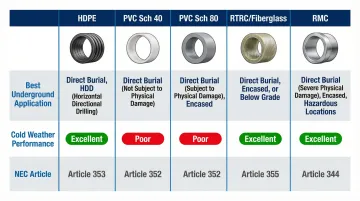
Conduit Material Comparison:
| Material | Best Underground Application | Cold Weather Performance | NEC Article |
|---|---|---|---|
| HDPE | Telecom, OSP, continuous HDD runs | Excellent (maintains ductility) | 353 |
| PVC Sch 40 | Standard direct burial/concrete | Poor (becomes brittle) | 352 |
| PVC Sch 80 | Physical damage areas | Poor (becomes brittle) | 352 |
| RTRC | Corrosive environments, industrial | Good | 355 |
| RMC | Severe physical damage zones | Excellent (requires coating) | 344 |
Prerequisites, Safety, and Tools
Prerequisites and Safety Considerations
Address these three requirements before any excavation begins:
- Call 811 for utility locates. Failure to notify 811 was the leading cause of utility damages in 2023, accounting for 35,825 incidents. California alone imposes fines up to $100,000 for willful violations — other states carry similar penalties.
- Verify permits and local code amendments. NEC Table 300.5 sets baseline burial depths, but local Authorities Having Jurisdiction (AHJs) often require greater depths for specific applications. Confirm all requirements before trenching.
- Assess soil conditions and trench safety. OSHA 29 CFR 1926.652 requires protective systems (shoring or sloping) for trenches 5 feet or deeper — but protection applies at any depth when a competent person identifies cave-in risk. A competent person must classify soil type (A, B, or C) daily before crew entry.
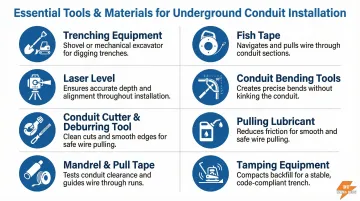
Tools and Materials Required
With safety prerequisites confirmed, assemble the following before breaking ground:
- Trenching equipment (manual or mechanical depending on run length)
- Laser level or grade stakes for slope control
- Conduit cutter or hacksaw with deburring tool
- Mandrel and pull tape for pathway validation
- Fish tape or mule tape for wire pulling
- Conduit bending tools (for PVC; HDPE typically uses sweeping radius bends)
- Pulling lubricant for cable installation
- Tamping equipment for backfill compaction
For HDPE installations, fusion or mechanical coupling systems may be required depending on joint method. DT Sales Reps supplies HDPE conduit, pull boxes, tools, and safety gear for electrical and OSP contractors — reach their team at DavidS@DTTexas.com or 281-900-1506 to confirm product availability before your project starts.
How to Install Underground Conduit: Step-by-Step
Underground conduit installation follows a defined sequence. Deviating from this order—especially backfilling before validation—is where the most expensive mistakes occur.
Step 1: Trench Excavation and Preparation
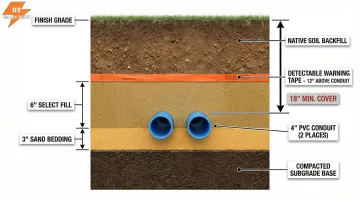
Dig to the correct depth per NEC Table 300.5 for your conduit type and voltage. For nonmetallic raceways like PVC and HDPE, standard minimum cover is 18 inches, increasing to 24 inches under streets, highways, roads, and driveways.
Ensure the trench bottom is smooth and free of rocks or debris that could damage conduit. Maintain a consistent slope of at least 4 inches per 100 feet toward pull boxes or manholes to allow drainage and prevent water accumulation.
Step 2: Bedding and Conduit Placement
Lay a sand or fine-gravel bedding layer of at least 3 inches before placing conduit. State DOT standards consistently require this protective bedding to prevent point-loading and rock impingement. Never place conduit directly on compacted clay or rocky substrate.
For multiple conduit runs, maintain proper spacing per code to prevent mechanical interference and allow future access. This spacing also facilitates heat dissipation for power cables.
Step 3: Joining, Bending, and Securing
Cut conduit square and deburr all ends before joining. Use manufacturer-approved couplings and appropriate solvent cement for PVC, or mechanical couplings for HDPE.
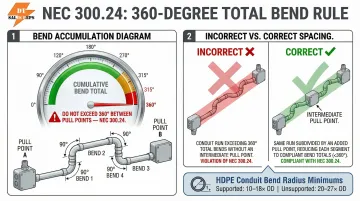
Keep bends at or above the minimum radius for the conduit type. Sharp field bends are a leading cause of failed cable pulls. HDPE bend radius minimums:
- Supported bends: 10–18× the outer diameter
- Unsupported bends during installation: 20–27× the OD
NEC 300.24 strictly limits total bends to 360 degrees between pull points—the equivalent of four 90-degree quarter bends. Plan pull point locations before trenching to stay within this limit.
Step 4: Conduit Fill Planning and Pull Tape Installation
Calculate conduit fill ratio before sealing runs. NEC Chapter 9, Table 1 limits fill to 40% for three or more conductors to prevent insulation damage during pulling and allow heat dissipation.
Install pull tape or mule tape during conduit placement, not after backfill. Seal conduit ends temporarily with approved caps to prevent debris and water ingress during backfilling.
Step 5: Initial Backfill
Cover conduit with 6 inches of compacted sand or select fill before adding native soil. Do not use heavy mechanical compaction directly over conduit until sufficient cover depth is achieved—this prevents deformation and cracking.
Place detectable warning tape 12 inches above conduit. Tape must meet two requirements:
- Metallic foil core for detection by locating equipment
- APWA color coding: red for electric power, orange for telecommunications
Common Underground Conduit Installation Mistakes and Fixes
The following mistakes cause the majority of project rework, code failures, and long-term system failures in underground conduit applications.
Mistake 1: Incorrect Burial Depth
Conduit buried too shallow fails NEC Table 300.5 minimums — a problem typically discovered during inspection or after surface damage occurs. The root cause is usually referencing a single depth figure without accounting for conduit type, voltage level, or road crossings. Contractors sometimes confuse the different columns in Table 300.5.
Confirm the correct NEC Table 300.5 row before trenching. Key minimums:
- PVC Schedule 80 direct burial: 18 inches minimum
- Concrete-encased PVC: can be reduced to 6 inches
- Runs under roadways: 24 inches regardless of conduit type
Always cross-reference local amendments — many municipalities require deeper burial than NEC minimums.
Mistake 2: Poor Trench Bedding and Backfill
Conduit placed directly on a rocky or uneven trench bottom — or backfilled with native soil containing debris — develops point loads that deform PVC and HDPE. The result: obstructions that block wire pulls or water pockets that accelerate cable deterioration.
Require a compacted sand bedding layer of at least 3 inches below conduit and 6 inches of select fill above before native soil is used. This is especially critical for PVC, which is highly susceptible to point-load deformation. Re-excavating a failed run typically costs more than an entire project's bedding material budget.
Mistake 3: Exceeding Bend Limits and Fill Ratios
Wire pulls that fail mid-run — or conductors that can't be fished through at all — are almost always a design problem, not a field problem. Common causes include accumulated bends exceeding NEC's 360-degree limit, field bends below minimum radius, or a fill ratio that exceeds NEC maximums. These issues surface only after backfill is complete.
Address this before trenching starts:
- Plan pull point locations (junction boxes or handholes) to keep bend totals within code
- Use long-radius sweep elbows instead of standard 90-degree fittings for underground runs
- Calculate conductor fill before finalizing conduit sizing — upsizing one trade size often prevents pull failures and creates capacity for future adds
Pro Tips and Final Validation Checklist
Pre-Backfill Validation
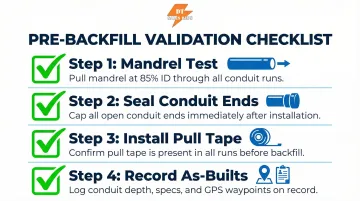
- Mandrel test every run: Pull a rigid mandrel sized at 85% of the conduit's inner diameter through all sections before covering. A failed pass means a deformation or obstruction that will stop cable pulls later — far cheaper to fix now than after backfill.
- Seal all exposed conduit ends: Cap open ends immediately after installation. Unsealed conduit is an entry point for insects, rodents, and water — all of which cause long-term cable damage and system failures.
Documentation and Locating
- Create as-built drawings: Record burial depth, conduit type/size, and GPS waypoints at every direction change and pull box. Utilities and municipalities increasingly require GPS coordinates accurate to within 3 feet — and this documentation is critical for future maintenance access.
- Install tracer wire for non-metallic conduit: On OSP and telecom runs, include #12 AWG Copper Clad Steel (CCS) tracer wire alongside HDPE and PVC conduit. Without it, electronic locating after burial is impossible and creates real liability during future excavations.
Sourcing and Supply
For large or multi-phase projects, work with a supplier who can confirm product availability, lead times, and compatibility across your full conduit, fitting, and tool range. Sourcing gaps mid-project are one of the most avoidable schedule killers.
DT Sales Reps supplies conduit, pull boxes, cable, safety products, and jobsite essentials to electrical and OSP contractors — with the product knowledge to match materials across a complete project scope. Contact their team at 281-900-1506 or DavidS@DTTexas.com.
Frequently Asked Questions
What is an underground conduit?
An underground conduit is a protective tube or pipe buried below ground to house and protect electrical wiring, telecommunications cables, or other utility lines from physical damage, moisture, and environmental hazards. It provides a permanent pathway that allows cables to be replaced or upgraded without re-excavation.
How deep does underground conduit need to be?
Minimum burial depths are governed by NEC Table 300.5 and range from 6 inches (concrete-encased PVC) to 24 inches (direct-buried conductors without conduit or any conduit under roadways). Depth varies by conduit type, voltage, and whether the run crosses roadways or driveways. Always verify local code amendments, which may require greater depths.
What type of conduit is best for underground?
The best choice depends on the application. HDPE suits OSP and telecom runs due to flexibility and impact resistance; PVC Schedule 40/80 works for most electrical applications; fiberglass (RTRC) handles corrosive industrial environments. Metal conduit is generally avoided underground due to corrosion susceptibility.
Can I run electrical wire underground without conduit?
Direct burial cable (such as UF-B) is permitted without conduit in some residential applications under NEC guidelines. For commercial and industrial work, conduit is typically required — and it provides critical protection that allows future cable replacement without re-excavation.
What mistakes most commonly cause underground conduit installations to fail?
The three most common failure causes are insufficient burial depth leading to surface damage or code violations, poor bedding and backfill practice causing conduit deformation, and exceeding NEC bend or fill limits that prevent successful cable pulls. All are avoidable with proper pre-installation planning.