
Introduction
Choosing the cheaper pipe upfront doesn't always mean spending less overall. Many contractors and distributors struggle to balance immediate budget constraints against long-term maintenance costs and system reliability. US infrastructure leakage accounts for approximately 2.2 trillion gallons of water lost annually, much of it traced to joint failures in segmented pipe systems.
That failure risk is part of why material selection matters as much as price.
PVC and HDPE are the two most common drainage pipe materials, and the cost gap between them goes well beyond a simple price tag comparison. This guide breaks down upfront material costs, installation expenses, and lifecycle costs for drainage applications, with a clear framework on when each pipe delivers better value for distributors and contractors.
Key Takeaways
- PVC has lower upfront material cost — HDPE pipe typically costs 85–115% more for equivalent drainage applications
- HDPE costs more initially but delivers 100+ year service life with leak-free fused joints
- PVC works best for standard open-trench drainage in stable soil with moderate conditions
- HDPE excels in underground conduit, trenchless installations, and challenging environments
- Total affordability depends on project timeline, site conditions, and lifecycle cost, not just the per-foot price
PVC vs HDPE Drainage Pipe: Quick Comparison
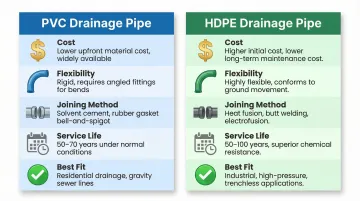
| Category | PVC | HDPE |
|---|---|---|
| Upfront Material Cost | $1.00–$2.50/ft (4-inch SDR 35); ~$9.90/ft (8-inch) | $5.37/ft (4-inch SDR 11); ~$18.38/ft (8-inch) — 85–115% premium over PVC |
| Composition & Flexibility | Rigid vinyl polymer; holds shape under static pressure but prone to cracking under impact or ground movement; becomes brittle below freezing | Semi-crystalline thermoplastic; handles ground shift and pressure cycling without cracking; rated from -40°F to 140°F |
| Joining Method | Solvent cement or gasket joints; standard tools only; potential leak points every 10–20 ft | Heat fusion creates monolithic, leak-free joints; requires trained operators and specialized equipment |
| Service Life | 50–70 years under normal conditions; stress regression testing suggests 100+ years in ideal environments | 100+ years; research confirms essentially unlimited fatigue resistance under standard operating conditions |
| Best Fit | Gravity drainage, storm sewers, stable-soil residential drainage, standard conduit | Trenchless installs, industrial drainage, OSP/telecom runs requiring continuous leak-free performance |
What Is PVC Drainage Pipe?
Polyvinyl Chloride (PVC) is a rigid vinyl polymer widely used in North American drainage applications since the 1950s. Its dominance in residential and commercial drainage stems from low cost, easy availability, and straightforward installation with standard tools—no specialized equipment required.
Core benefits for drainage include:
- High rigidity maintains alignment and shape in gravity-fed drainage systems
- Strong chemical resistance to many common drainage fluids, including sulfuric acid (up to 80%) and sodium hydroxide
- Lightweight construction makes it easy to cut and join on the jobsite
- Familiar installation allows standard crews to work efficiently without specialized training
Use Cases of PVC in Drainage
PVC covers a wide range of drainage applications, particularly where soil conditions are stable and budgets are tight:
- Gravity sewer lines and municipal stormwater systems
- Residential drain-waste-vent (DWV) systems
- Irrigation drainage and landscaping runoff
- Commercial building drainage
- Short-run electrical conduit in low-exposure settings
These cost advantages come with trade-offs that affect where PVC makes the most financial sense long-term:
- Becomes brittle below freezing and can crack under impact or soil movement
- UV degradation occurs after 1-2 years of direct outdoor exposure without protective coating
- Segmented construction creates potential leak points at every joint
- Less suitable for environments with significant ground movement or seismic activity
What Is HDPE Drainage Pipe?
High-Density Polyethylene (HDPE) is a semi-crystalline thermoplastic made from petroleum. Its flexibility, chemical inertness, heat-fused joints, and wide temperature tolerance make it the preferred choice for demanding drainage and conduit applications—particularly underground and trenchless installs.
Core benefits for drainage and conduit:
- Flexibility absorbs ground movement without cracking, making it ideal for unstable soil
- Heat fusion joints create a monolithic, leak-free system
- Superior UV resistance eliminates special handling for outdoor storage and transport—HDPE with 2-3% carbon black resists UV degradation for 10+ years
- Wide temperature range from -40°F to 140°F enables reliable performance in extreme climates
HDPE dominates OSP (outside plant) and telecommunications conduit applications—a natural fit for OSP contractors and distributors who need flexible, continuous runs with zero leak tolerance.
Use Cases of HDPE in Drainage
HDPE is specified across a wide range of applications:
- Underground stormwater systems and force mains
- Pressure drainage and trenchless installs via HDD or pipe bursting
- Electrical and telecommunications conduit
- Mining and industrial drainage
Reliability advantage: Both materials perform well long-term—Utah State University research documents PVC at just 2.6 breaks per 100 miles/year—but HDPE outperforms PVC under cyclic stress and ground movement, which matters most in trenchless and underground applications.
DT Sales Reps supplies HDPE conduit for distributors and OSP contractors, with an empty HDPE reel buyback program that helps offset higher material costs on large-scale projects by recovering value from used reels.
PVC vs HDPE Drainage Pipe Cost: Full Breakdown
Upfront Material Cost
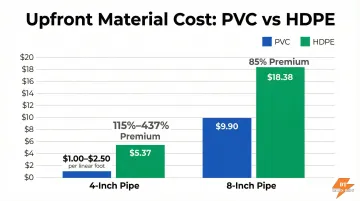
Based on current market pricing:
- 4-inch PVC SDR 35: $1.00–$2.50 per linear foot
- 4-inch HDPE SDR 11: $5.37 per linear foot (115–437% premium)
- 8-inch PVC SDR 35: $9.90 per linear foot
- 8-inch HDPE SDR 11: $18.38 per linear foot (85% premium)
HDPE is generally 85–115% more expensive at the point of purchase for common drainage sizes, significantly higher than the often-cited "15–30% premium."
Installation Cost Differences
PVC advantages:
- Installs faster with standard crew skills—no fusion equipment needed
- Standard pipelayer labor rates (mean $25.41/hr) apply
- Requires only basic tools, primer, and cement or gasket lubricants
HDPE requirements:
- Certified fusion operators (qualification courses cost $500–$1,200 per operator)
- Specialized McElroy fusion equipment (rental costs hundreds of dollars daily)
- DataLogger QA devices ($7,000–$8,800 purchase price)
- Higher day-rate labor cost but produces zero-leak joints that eliminate future remediation
Transportation and Handling Cost
HDPE's handling profile offers two cost advantages over rigid PVC:
- No UV protection needed: HDPE's built-in UV resistance eliminates covered transport or protective wrapping costs required for PVC
- Coiled delivery for smaller diameters: A single 96-inch reel holds up to 5,000 feet of 2-inch HDPE conduit, cutting freight costs sharply compared to rigid 10–20 foot PVC sticks shipped on pallets
Lifecycle and Maintenance Cost
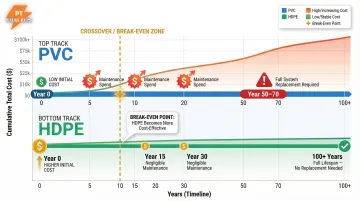
HDPE's 100+ year service life and near-zero leak rate mean fewer replacements and repair callouts over the project lifespan. PVC, while durable under ideal conditions (50–70 years), is more susceptible to joint leaks, cracking in unstable soil, and UV degradation—each adding to long-term spend.
According to JM Eagle's lifecycle analysis, approximately 2.2 trillion gallons of water are lost annually in the US from infrastructure leakage, much of it traced to joint failures in segmented systems. HDPE's monolithic fused joints eliminate this failure point entirely.
Total Cost of Ownership Summary
That failure-rate gap is where HDPE earns back its price premium. For short-term, stable-soil drainage projects with standard budgets, PVC typically delivers lower total cost. For long-lifecycle infrastructure, underground conduit, or trenchless drainage projects, HDPE's higher upfront cost typically pays back within the first decade through reduced maintenance, fewer joint failures, and longer replacement intervals.
Which Drainage Pipe Is Right for Your Project?
Key Factors to Evaluate Before Choosing
Evaluate these criteria before choosing:
- Soil stability, temperature range, and UV exposure at the project site
- Whether installation is open trench or trenchless
- Upfront budget vs. total lifecycle cost
- Required pipe diameter and pressure rating
Choose PVC If:
- Budget is the primary constraint
- Project involves above-grade or gravity drainage in stable soil
- Installation crews lack fusion equipment
- Conditions are moderate (no extreme temperatures, no ground movement risk)
- Project timeline is short and replacement cycles are acceptable
Choose HDPE If:
- Project involves underground or trenchless drainage
- Application is conduit for electrical or OSP telecommunications
- Exposure to extreme temperatures or shifting soil is expected
- Long-term reliability and a leak-free system outweigh higher initial spend
- Seismic resilience is required — HDPE's ductility prevented failures during the 1995 Kobe earthquake where segmented pipes failed (NIST SP 901)
For OSP contractors and distributors sourcing conduit at volume, HDPE's durability and installation flexibility typically make it the lower-risk choice over the life of the project.
Conclusion
PVC costs less upfront. HDPE costs less over time. The right choice depends on project conditions, soil stability, installation method, and lifecycle budget, not just the unit price.
When evaluating which material fits a specific job, consider:
- Upfront budget constraints — PVC is the lower-cost entry point for stable, low-stress environments
- Long-term durability needs — HDPE holds up better in shifting soils, trenchless installs, and high-flex applications
- Total installed cost — labor, fittings, and jointing method all affect the final number
For distributors and contractors looking to source HDPE conduit or compare material options for an upcoming project, DT Sales Reps supplies HDPE conduit, PVC, pull boxes, and jobsite essentials to electrical and OSP contractors across the supply chain. Contact the team at 281-900-1506 or DavidS@DTTexas.com to discuss project needs and available supply.
Frequently Asked Questions
Is HDPE pipe more expensive than PVC for drainage projects?
Yes, HDPE is generally 85-115% more expensive per linear foot at purchase for common drainage sizes. However, total project cost depends on installation method, soil conditions, and expected system lifespan. HDPE's leak-free joints and 100+ year service life frequently offset that upfront cost.
What factors affect the cost difference between PVC and HDPE drainage pipe?
Pipe diameter, pressure rating, installation method (open trench vs. trenchless), crew certification requirements, and site conditions like soil stability and temperature range all affect the final cost. Logistics matter too: HDPE ships in continuous coils while PVC requires palletized rigid sticks, which affects freight pricing.
Which drainage pipe lasts longer, PVC or HDPE?
HDPE offers an estimated 100+ year service life compared to PVC's 50-70 years under normal conditions. Its measurably lower failure rate under cyclic stress and monolithic fused joints make it the preferred material for infrastructure projects where longevity is a priority.
Can HDPE and PVC drainage pipes be connected to each other?
HDPE and PVC cannot be directly fused together. However, transition fittings (mechanical or flanged) allow the two materials to be used together in mixed systems, enabling contractors to leverage the strengths of each material where appropriate.
Which pipe is better for underground or trenchless drainage installations?
HDPE is the clear choice for underground and trenchless applications. Its flexibility, heat-fused leak-free joints, and compatibility with HDD and pipe-bursting methods make it ideal for installations where excavation is limited or impossible.
Is PVC or HDPE easier to install for drainage systems?
PVC is simpler to install using standard tools and cement joints, with no specialized training required. HDPE demands certified fusion operators and dedicated equipment, adding complexity. That said, HDPE's coiled delivery and fewer fittings can reduce labor time on long continuous runs.