
Introduction
A frozen PVC pipe can split without warning, causing thousands of dollars in property damage. For contractors and distributors specifying freeze protection, there's a less obvious failure mode: the wrong heat tape melting the pipe before freezing is ever a factor.
PVC begins to soften at 140°F, and certain constant-wattage heat cables routinely exceed that threshold — particularly at overlaps, under insulation, or around fittings where heat cannot dissipate. According to Charlotte Pipe and JM Eagle, the maximum recommended operating temperature for PVC pressure pipe is 140°F (60°C). Cable selection is a functional safety requirement, not a secondary spec.
This guide covers the best self-regulating heat tape options tested and rated for PVC compatibility, what specifications matter most, and how to install correctly to protect your pipes without risking thermal damage.
Key Takeaways
- Self-regulating heat tape is the only safe choice for PVC—constant-wattage cables can melt the pipe
- Target approximately 6 watts per foot for residential PVC freeze protection
- Always pair heat tape with minimum ½-inch pipe insulation to maintain performance
- Look for UL listing and explicit "PVC-compatible" labeling before purchasing
- Plug into GFCI-protected outlets to meet code requirements
Why PVC Pipes Require Special Heat Tape
PVC's 140°F Softening Threshold Makes Cable Selection Critical
PVC pipe manufacturers set strict thermal limits for good reason. Charlotte Pipe and JM Eagle both specify 140°F (60°C) as the maximum recommended operating temperature for their PVC pressure pipes. Push beyond that, and the material begins to deform. ASTM D1525 testing shows the Vicat Softening Point for high-impact PVC averages 176°F, but softening begins at the lower end of that range—around 172°F.
That narrow margin between safe operation and material failure is where cable selection becomes critical. Constant-wattage cables generate fixed heat output regardless of ambient temperature — at overlaps, under thick insulation, or around metallic fittings that concentrate heat, they can easily push pipe surfaces past PVC's safe operating range.
Self-Regulating vs. Constant-Wattage: Understanding PTC Technology
Self-regulating heat cables use a semiconductive polymer core — called a PTC (Positive Temperature Coefficient) core — extruded between two parallel bus wires. When surrounding temperature drops, the polymer becomes more conductive and output increases. When temperature rises, electrical resistance climbs and output pulls back automatically.
This built-in response prevents overheating even if the cable overlaps or gets bunched under insulation. Constant-wattage cables have no equivalent mechanism. Key behavioral differences:
- Self-regulating: Output adjusts continuously to pipe temperature; safe to overlap
- Constant-wattage: Fixed output regardless of conditions; overlaps create localized hot spots
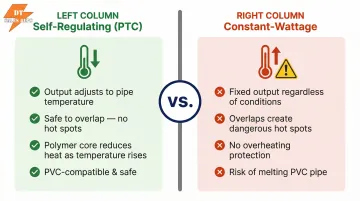
Manufacturers like Chromalox and Thermon explicitly warn against overlapping constant-wattage cables — the resulting hot spots generate enough heat to melt PVC and create fire hazards.
UL Listing and "PVC-Compatible" Labeling Are Non-Negotiable
The fastest way to confirm a heat cable is safe for plastic pipe: check for UL listing and explicit "PVC-compatible" language on the product's spec sheet. This is a frequent oversight during procurement. Some cables marketed for freeze protection are rated for metal pipe only and will damage PVC on contact. Confirm compatibility on the spec sheet before purchase — not after the pipe is wrapped and insulated.
Best Heat Tape for PVC Pipes: 2026 Top Picks
Each product was evaluated across five criteria:
- Self-regulating (PTC) technology
- Watt-per-foot output relative to PVC safety thresholds
- PVC compatibility rating
- Warranty terms
- Real-world installer feedback
Heat Tape Pro (Radiant Solutions Company)
Commercial-grade self-regulating cable available in 6W and 8W versions at both 120V and 240V. The 6W version is the preferred choice for PVC pipe protection and is sold on spools for cut-to-length customization, making it ideal for complex routing or large projects.
Key features:
- GlowCap end indicator (green LED confirms live power at a glance)
- Field-repairable with standard splice and end seal kits
- 10-year warranty — longest in this product category
- Domestic manufacturing for consistent quality control
| Feature | Specification |
|---|---|
| Power Output | 6W/ft or 8W/ft (120V or 240V) |
| PVC Compatible | Yes, up to 6-inch diameter pipe |
| Warranty | 10 years |
Raychem FrostGuard
A widely available plug-in self-regulating cable rated at approximately 6W/ft at 40°F, designed for straightforward plug-in installs. You'll find it at most home improvement retailers, making it accessible for quick replacements or same-day projects.
Key features:
- PVC-safe up to 6-inch diameter; overlap-safe PTC core
- UL-listed for North American installations
- Fixed lengths only — not cut-to-order
- 10-year extended warranty available with registration within 30 days
| Feature | Specification |
|---|---|
| Power Output | ~6W/ft (120V) |
| PVC Compatible | Yes, up to 6-inch diameter |
| Warranty | 2 years (10 years with registration) |
ThermoSoft NeverFreeze
Industrial-grade self-regulating cable built for demanding commercial and municipal pipe freeze protection applications. Rated at 5W/ft at 50°F, it's compatible with a wide range of pipe materials including PVC, and available in custom lengths for large-scale installations.
Best suited for water treatment facilities, commercial buildings, and multi-site installations where robust PTC construction is a specification requirement. Availability varies by distributor, and warranty terms depend on the purchasing channel.
| Feature | Specification |
|---|---|
| Power Output | Self-regulating PTC (5W/ft at 50°F) |
| PVC Compatible | Yes, all pipe sizes |
| Warranty | 3 years |
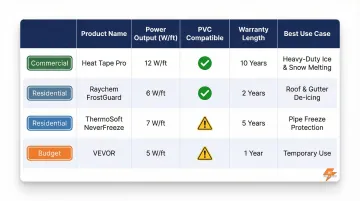
Frost King HC Kit
A constant-wattage kit with a built-in thermostat, marketed as PVC-compatible within a narrow pipe size range (up to 1.5 inches only). It's the lowest-cost option in this roundup and widely available at hardware stores.
Frost King's own FAQ states: "Can I use the Heat Cables on my PVC pipes? nope. Sorry. They aren't made for PVC pipes." The built-in thermostat (on at 38°F, off at 45°F) partially limits overheating risk, but the constant-wattage output of ~7W/ft still exceeds the safe ceiling for PVC.
This product is not professional grade and is not suitable for larger-diameter plastic pipe.
| Feature | Specification |
|---|---|
| Power Output | 7W/ft (120V) |
| PVC Compatible | Limited (up to 1.5-inch pipe only) |
| Warranty | Limited/short-term |
VEVOR Pipe Cable
A budget-tier self-regulating cable using legitimate PTC technology. Rated at approximately 5W/ft at 120V and IP68-rated for waterproofing, making it a workable choice for basic residential pipe protection.
Quality control and warranty support vary by batch. Before purchasing, verify safety certifications — UL, ETL, or equivalent. VEVOR claims CE certification but does not publish verifiable UL or ETL certificate IDs in official documentation. Missing a recognized safety listing is a disqualifying factor for any commercial or code-inspected installation, regardless of price.
| Feature | Specification |
|---|---|
| Power Output | ~5W/ft (120V) |
| PVC Compatible | Yes, 0.5–2 inch diameter |
| Warranty | ~3 years (varies) |
How to Choose the Right Heat Tape for Your PVC Pipes
Match Cable Configuration to Pipe Diameter
Pipe diameter determines how you run the cable:
- Under 1 inch: Single straight cable run along the bottom of the pipe
- 1–6 inches: One cable, straight run at the 6 o'clock position
- Over 6 inches: Two cables run along opposite sides (4 o'clock and 8 o'clock positions)
Always confirm the manufacturer's diameter table before ordering. Running two cables when one is sufficient wastes money; running one when two are needed leaves sections vulnerable to freezing.
Calculate Total Cable Length Accurately
Measure the pipe run, then add footage for:
- Valves: Add approximately 1 foot per valve to account for increased heat loss at these metallic heat sinks
- Complex routing: Extra cable needed to navigate around fittings, elbows, and tees
- Distance to outlet: Don't forget the run from the last protected section to your power source
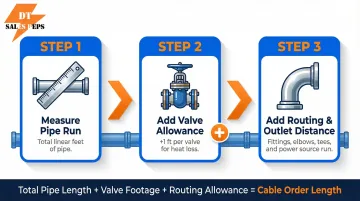
For projects over 50 linear feet, spool cable (like Heat Tape Pro) is more cost-effective than pre-cut kits. If you're slightly over on a pre-cut kit, spiral the excess evenly along the pipe rather than cutting it off.
Indoor vs. Outdoor: Insulation Spec Matters
The cable type stays the same, but insulation requirements change. Outdoor PVC pipes exposed to wind chill need heavier pipe insulation on top of the heat tape. Minimum ½-inch foam insulation with a vapor barrier is standard practice in humid or crawl-space environments.
The 2012 IECC Section C404.5 defers to manufacturer specifications, and manufacturers universally require at least ½-inch fire-resistant, waterproof thermal insulation. In extreme environments requiring protection down to -20°F, increase insulation thickness to 1 inch.
Thermostatic Controllers: When They Make Sense
Self-regulating cables run continuously at variable power output. Adding a thermostatic controller (typically set to cut power above 35–40°F) can cut energy consumption in regions with fluctuating winter temperatures.
Thermon benchmark testing reveals that electronic line-sensing controllers consume only 19% of the power used by standard ambient-sensing thermostats—an 81% reduction. For large-scale commercial installations, the payback period can be under two heating seasons.
Sourcing for Commercial and Multi-Site Projects
Once your specs are locked in, procurement becomes the next variable. For contractors sourcing heat tape at volume across multi-site or commercial projects, DT Sales Reps supplies consistent product availability alongside conduit, cable, and jobsite essentials — so your materials ship together, correctly specced. Contact DT Sales Reps at 281-900-1506 or DavidS@DTTexas.com to discuss volume sourcing.
Installation Tips and Common Mistakes to Avoid
Run Cable Straight Along the Bottom—Don't Spiral
Install the cable straight along the bottom of the pipe (the 6 o'clock position) for most applications. Spiraling uses more cable—often 30–50% more—with no freeze protection advantage for standard pipe diameters. Secure with fiberglass installation tape every 6–12 inches—not duct tape or over-tightened zip ties that can cut into the cable jacket.
For plastic pipes specifically, manufacturers recommend aluminum foil tape to better distribute heat and prevent localized hot spots. Apply at 12-inch intervals.
Four Critical Safety Rules
Avoid these four practices on every installation:
- Using constant-wattage cable on PVC—the most common and most dangerous mistake
- Installing heat tape inside the pipe
- Overlapping constant-wattage cable sections
- Plugging into an unprotected outlet—NEC Article 427.22 requires Ground-Fault Protection of Equipment (GFPE) with a 30mA trip level for all electric heat tracing circuits
- Using an extension cord, which creates both a code violation and a fire hazard
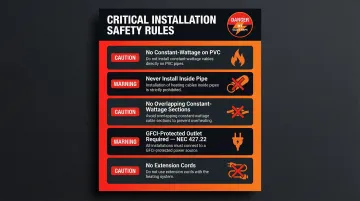
Most jurisdictions require GFCI-protected outlets—confirm this with your local inspector before final hookup.
Insulate After Cable Installation, Then Test
Add pipe insulation over the heat tape, not before. In damp locations, add a vapor barrier over the insulation. Before covering the installation permanently, test the cable by confirming warmth to the touch or checking the indicator LED (if equipped).
Inspect the full installation annually before each heating season. Self-regulating cables are durable, but check for:
- Cracks or fraying in the cable jacket
- Signs of UV degradation on exposed sections
- Physical damage from construction activity
- Rodent chew marks along the cable run
Conclusion
PVC pipe protection comes down to one non-negotiable starting point: self-regulating cable with a wattage output rated safe for plastic. Constant-wattage products risk both pipe damage and fire hazard. The 5–7 W/ft range is the established standard because it delivers adequate freeze protection while staying well below PVC's 140°F thermal limit.
Evaluate total cost of ownership, not upfront price alone. A 10-year cable that costs more per foot consistently outperforms a budget kit across even a single heating season. Factor in:
- Energy efficiency over continuous operation
- Field-repairability when damage occurs mid-run
- Full replacement cost when a failed installation has to come out
When your specs are locked in, sourcing the right product quickly is what keeps the project on schedule. Distributors, electrical contractors, and construction teams can reach DT Sales Reps at 281-900-1506 or DavidS@DTTexas.com to discuss freeze protection materials and jobsite supply needs.
Frequently Asked Questions
Can I use heat tape on PVC pipe?
Yes, but only self-regulating heat tape rated for plastic pipe. PVC softens at around 140°F, and constant-wattage tapes can reach or exceed that threshold, especially under insulation or at overlaps. Always verify the product spec sheet includes explicit "PVC-compatible" language.
Is it okay to leave heat tape plugged in all the time?
Self-regulating heat tape is designed for continuous operation and automatically adjusts output based on temperature, so it's safe to leave plugged in all winter. A thermostatic controller can reduce energy use during milder weather, but constant-wattage tape should not be left unmonitored without one.
How can I keep my PVC pipes from freezing in cold weather?
Use a combination approach: install self-regulating heat tape along the pipe, add foam pipe insulation over it, plug into a GFCI outlet, and energize the cable before temperatures drop below freezing. Insulation is critical to effectiveness — skipping it forces the tape to fight ambient air instead of protecting the pipe.
What wattage heat tape is safe for PVC pipes?
6 watts per foot is the generally accepted safe output for PVC pipe protection. Self-regulating cables stay at or below this threshold dynamically as temperature rises, while some constant-wattage products exceed it under insulated conditions, making them unsuitable for plastic pipe regardless of thermostat use.
Do I need to insulate PVC pipes after installing heat tape?
Yes — without insulation, heat tape loses effectiveness quickly in extreme cold because it's fighting ambient air instead of warming the pipe. Use at minimum ½-inch foam insulation with a vapor barrier in damp environments, and increase to 1-inch thickness for protection down to -20°F.
What is the difference between self-regulating and constant-wattage heat tape?
Self-regulating cable uses a polymer core that automatically reduces output as temperature rises, preventing overheating and allowing safe overlaps. Constant-wattage cable outputs the same heat regardless of conditions and cannot safely overlap; localized hot spots will melt PVC. Self-regulating is the only appropriate choice for plastic pipe.