
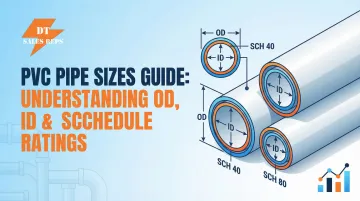
Introduction
A 2" PVC pipe doesn't measure 2 inches across — it measures 2.375" at the outside diameter. That gap between nominal size and actual dimension catches contractors and engineers off guard regularly, and the result is mismatched fittings, undersized systems, and pressure failures that could have been avoided at the specification stage.
Getting the terminology right — Nominal Pipe Size (NPS), outside diameter (OD), inside diameter (ID), and schedule ratings — is the foundation of correct pipe selection and fitting compatibility. Nominal size is a reference label, not a measurement. Schedule ratings control wall thickness, which determines both pressure capacity and flow volume.
Mixing up OD with nominal size, or treating Schedule 40 and Schedule 80 as interchangeable, leads directly to incompatible fittings and compromised pressure performance.
This guide covers how the NPS system works, what schedule numbers actually mean, available size ranges, pressure and temperature limits, and how to specify correctly for both pressure pipe and electrical conduit applications.
Key Takeaways
- PVC pipe uses Nominal Pipe Size (NPS), which approximates inside diameter—not outside diameter
- OD is fixed for each nominal size regardless of schedule; schedule determines wall thickness and pressure rating
- Schedule 80 has thicker walls than Schedule 40, giving higher pressure ratings but smaller inside diameters
- Pressure ratings drop with temperature: a pipe rated 450 PSI at 73°F falls to 99 PSI at 140°F
- ASTM D1785 governs pressure pipe; always match fitting schedule to pipe schedule for safe assembly
What PVC Pipe Sizing Actually Means: NPS, OD, and ID Explained
PVC pipe is sized using the Nominal Pipe Size (NPS) system—a standardized naming convention, not a direct measurement. Neither OD nor ID precisely matches the nominal label, especially in sizes under 12". A pipe labeled "1 inch" does not have a 1" outside diameter; it has a 1.315" OD.
The Historical Origin of NPS
The NPS system is derived from the legacy Iron Pipe Size (IPS) system, established around approximate bore sizes in older iron pipe standards. PVC manufacturers adopted the same OD values so fittings would be interchangeable with existing steel and iron piping systems. That's why the nominal label is a reference number, not a true bore measurement.
For sizes under 12", the nominal size is significantly smaller than the OD. For example:
- ½" nominal = 0.840" OD
- 2" nominal = 2.375" OD
- 6" nominal = 6.625" OD
For 14" and above, nominal size and OD converge exactly—a 14" nominal pipe has a 14.000" OD.
Because OD is constant for a given nominal size, fittings are designed around OD. A ¾" Schedule 40 fitting will physically accept ¾" Schedule 80 pipe—both share a 1.050" OD. The internal socket bore dimensions differ, however, to match each schedule's respective ID.
Keep these two rules in mind on every job:
- Mixing Schedule 40 fittings with Schedule 80 pipe (or vice versa) creates dimensional mismatches inside the assembly, causing flow restrictions, turbulence, and pressure loss—always match fitting schedule to pipe schedule
- OD alone won't tell you nominal size without a reference chart; measure the ID and cross-reference against ASTM D1785 tables to identify unlabeled pipe
Available PVC Pipe Sizes and Their Applications
Standard pressure-grade PVC pipe under ASTM D1785 typically ranges from ½" through 16" for Schedule 40 and 80. Schedule 40 is also available in larger industrial sizes. DWV (drain, waste, vent) pipe under ASTM D2665 and sewer pipe under ASTM D3034 extend to larger diameters with different wall standards.
That range translates directly into application categories — here's how size maps to common use cases.
Application-Driven Size Selection
Smaller sizes (½" to 2"):
- Residential plumbing and water distribution
- Irrigation systems and drip lines
- Low-voltage electrical conduit runs
Mid-range sizes (2½" to 6"):
- Commercial plumbing systems
- Industrial process piping
- Electrical conduit for commercial installations
- Main drain and vent systems
Larger sizes (8" to 16"):
- Industrial flow systems
- Underground utilities and infrastructure
- Municipal water mains
- Large-scale stormwater management
PVC Conduit for Electrical Applications
For electrical conduit applications—a key use case for contractors—Schedule 40 and Schedule 80 PVC conduit follows the same NPS sizing convention. For distributors consolidating conduit, pull boxes, and cable into a single order, DT Sales Reps stocks a comprehensive range to match sizing requirements across project types.
Note on availability: Not all schedules are available at all sizes. Schedule 120, for example, is only manufactured in smaller diameters (typically ½" through 8"). Availability varies by supplier and application standard.
Schedule Ratings: How They Define Wall Thickness, ID, and Pressure Capacity
A schedule number is a dimensionless index that specifies minimum wall thickness for a given nominal pipe size. The system originated from the formula:
Schedule = 1000 × (P / S)
Where P is service pressure (PSI) and S is allowable stress (PSI). Schedule numbers—40, 80, 120—describe wall thickness categories; higher numbers mean thicker walls. For example, a system running 450 PSI against a 10,000 PSI allowable stress would calculate to Schedule 45, rounding up to Schedule 80 in practice.
The Core Trade-Off: Pressure vs. Flow
Because OD is fixed but wall thickness increases with schedule, a higher schedule pipe has a smaller ID for the same nominal size. This means:
- Schedule 80 carries less flow volume than Schedule 40 at equal nominal size
- Schedule 80 withstands higher pressure than Schedule 40 at equal nominal size
Visual Identification
- Schedule 40: White PVC
- Schedule 80: Dark gray PVC
Comparative Dimensions and Pressure Ratings
Table: Schedule 40 vs. Schedule 80 (ASTM D1785, 73°F Water)
| Nominal Size | OD (in) | Sch 40 Wall | Sch 80 Wall | Sch 40 ID | Sch 80 ID | Sch 40 PSI | Sch 80 PSI |
|---|---|---|---|---|---|---|---|
| ½" | 0.840 | 0.109" | 0.147" | 0.622" | 0.546" | 600 | 850 |
| ¾" | 1.050 | 0.113" | 0.154" | 0.824" | 0.742" | 480 | 690 |
| 1" | 1.315 | 0.133" | 0.179" | 1.049" | 0.957" | 450 | 630 |
| 2" | 2.375 | 0.154" | 0.218" | 2.067" | 1.939" | 280 | 400 |
| 4" | 4.500 | 0.237" | 0.337" | 4.026" | 3.826" | 220 | 320 |
| 6" | 6.625 | 0.280" | 0.432" | 6.065" | 5.761" | 180 | 280 |
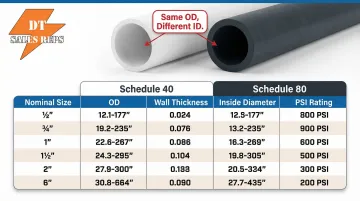
Data sourced from ASTM D1785 specifications
Where Each Schedule Is Applied
Schedule 40:
- Standard for residential and commercial plumbing
- Irrigation systems
- Non-chemical electrical conduit
- General-purpose water distribution
Schedule 80:
- Higher working pressures
- Chemical exposure environments
- Protects against mechanical damage in exposed installations
- Industrial process piping
Do not mix Schedule 40 and Schedule 80 fittings. Even though pipe OD is identical across schedules, socket dimensions inside fittings differ. A Schedule 40 fitting on Schedule 80 pipe produces poor solvent-cement joints and compromised pressure performance.
Pressure Ratings, Temperature Limits, and Safety Margins
Published PSI ratings for PVC pipe assume 73°F water service—these are baseline values from ASTM D1785. For example, a 1" Schedule 40 pipe is rated for 450 PSI at 73°F. These ratings decrease significantly as temperature increases.
The Temperature De-Rating Factor System
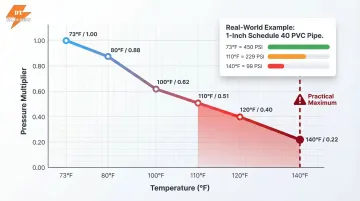
PVC loses pressure-handling capacity at elevated temperatures, reaching roughly 50% of rated pressure around 110°F and dropping to about 22% at 140°F—the practical maximum for PVC.
Table: Temperature De-Rating Factors
| Operating Temperature | De-Rating Multiplier |
|---|---|
| 73°F | 1.00 |
| 80°F | 0.88 |
| 100°F | 0.62 |
| 110°F | 0.51 |
| 120°F | 0.40 |
| 140°F | 0.22 |
Real-world example: A 1" Schedule 40 pipe rated for 450 PSI at 73°F drops to:
- 229 PSI at 110°F (0.51 × 450)
- 99 PSI at 140°F (0.22 × 450)
Pressure Ratings Decrease as Pipe Size Increases
Within the same schedule, pressure ratings drop as diameter increases. A ½" Schedule 40 pipe handles 600 PSI, but a 6" Schedule 40 pipe handles only 180 PSI. This occurs because larger diameters require more material to contain the same internal pressure—thin-wall stress increases with radius.
That physics has a direct implication for system design: always base system limits on the pressure rating of the largest pipe diameter in the run, not the smallest.
Safety margins: Published ASTM D1785 ratings already include a 2:1 design safety factor. Even so, running continuously at or near rated pressure—particularly at elevated temperatures or under water hammer conditions—accelerates creep and shortens service life. For sustained high-pressure applications, target 50–70% of the rated pressure as your working ceiling.
How to Measure, Specify, and Avoid Common Sizing Mistakes
Correct Field Measurement Method
To identify nominal size of unlabeled pipe:
- Measure the outside diameter (OD) using calipers or a wrap tape
- If using a flexible tape, measure the circumference and divide by π (3.14159) to find OD
- Cross-reference the OD against an ASTM D1785 nominal size chart
Do not attempt to measure ID on installed pipe, and never assume nominal size equals OD.
What to Verify When Specifying PVC Pipe
Always specify these five parameters:
- Nominal size (e.g., 2")
- Schedule (40, 80, or 120)
- Material standard (ASTM D1785 for pressure; D2665 for DWV; D3034 for sewer)
- Operating temperature (for de-rating calculations)
- Operating pressure (to ensure rating exceeds system requirements)
Understanding Pipe Markings
Per ASTM D1785, PVC pressure pipe must be permanently marked with:
- Manufacturer's name or trademark
- Nominal pipe size
- Material designation code (e.g., PVC 1120)
- Pipe schedule (e.g., Schedule 40 or 80)
- Pressure rating in PSI for water @ 73°F
- ASTM designation (ASTM D1785)
- Independent laboratory seal (e.g., NSF for potable water)
Three Most Common Sizing Errors
Confusing nominal size with OD — A 2" nominal pipe has a 2.375" OD, not 2.000". Use actual OD values for all clearance calculations.
Swapping Schedule 40 for Schedule 80 on nominal size alone — Schedule 40 carries lower pressure ratings and thinner walls. Chemical resistance and mechanical protection also differ between schedules.
Skipping temperature de-rating — A system running at 110°F requires a 0.51 de-rating factor applied to the room-temperature pressure rating. Ignoring this causes long-term creep and burst risk.
The Telescoping Question: Which Pipes Fit Inside Each Other?
OD is fixed per nominal size, but ID varies by schedule — which means certain size-and-schedule combinations allow one pipe to slide inside another. Contractors use this intentionally in telescoping assemblies and conduit nesting.
However, most adjacent nominal sizes do NOT telescope. You must calculate exact OD-to-ID clearance using dimension tables.
Table: Telescoping Feasibility Examples
| Inner Pipe (OD) | Outer Pipe (ID) | Clearance | Result |
|---|---|---|---|
| ¾" Sch 80 (1.050") | 1" Sch 40 (1.049") | -0.001" | Does not fit |
| ½" Sch 80 (0.840") | ¾" Sch 40 (0.824") | -0.016" | Does not fit |
| 1" Sch 80 (1.315") | 1-¼" Sch 40 (1.380") | +0.065" | Fits |
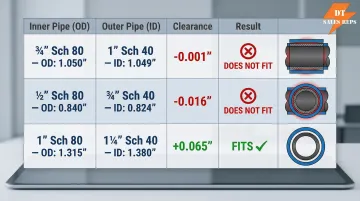
Always verify exact dimensions from ASTM D1785 tables before assuming adjacent sizes will telescope — the clearances are tight enough that even a 0.001" gap disqualifies a fit.
Frequently Asked Questions
What sizes do PVC pipes come in?
Standard pressure-grade PVC pipe under ASTM D1785 runs from ½" to 16" nominal size in Schedules 40 and 80, while DWV and sewer pipe standards cover larger diameters. Residential use typically stays in the ½" to 4" range, with commercial and industrial applications extending to 16" and beyond.
Is Schedule 40 or 80 PVC bigger?
Both schedules share the same outside diameter for a given nominal size, but Schedule 80 has thicker walls—giving it a smaller inside diameter and higher pressure rating than Schedule 40 of the same nominal size. For example, 1" Schedule 40 has a 1.049" ID, while 1" Schedule 80 has a 0.957" ID.
What size PVC pipe fits into each other?
Pipe telescoping depends on comparing the OD of a smaller pipe against the ID of a larger one. Because Schedule 80 has a smaller ID than Schedule 40 of the same nominal size, combinations like 1" Schedule 80 inside 1-¼" Schedule 40 can work, but most adjacent nominal sizes do not telescope — always verify actual dimensions before assuming fit.
Why doesn't nominal pipe size match the actual outside diameter?
The NPS system originated with iron pipe where nominal size approximated the bore. PVC adopted the same OD values for fitting interchangeability, so nominal labels are reference designations, not direct measurements. The OD is always larger than the nominal number for sizes under 12"; at 14" and above, nominal size and OD match exactly.
What ASTM standards govern PVC pipe dimensions and pressure ratings?
ASTM D1785 covers Schedule 40, 80, and 120 pressure pipe; ASTM D2665 covers DWV pipe; and ASTM D3034 covers PVC sewer pipe. Each standard defines wall thickness, OD tolerances, and testing requirements. Never substitute DWV or sewer pipe in pressure applications.