Introduction
A metal conduit rusts through after a single rainy season. The wiring inside fails. The contractor faces costly rework, project delays, and an unhappy client. This scenario plays out on jobsites across the country when the wrong flexible conduit is chosen for outdoor applications—a decision that carries real project risk.
For contractors and distributors, selecting outdoor flexible conduit goes beyond material cost. Safety code compliance, long-term durability under sun, rain, and temperature extremes, and avoiding mid-project replacements all factor into the decision—each one capable of affecting margins and timelines when overlooked.
This guide covers the types of flexible conduit rated for outdoor use and the six critical selection criteria you must verify. It also walks through how to match conduit to specific applications—HVAC equipment connections, underground utility runs, and more—so your next outdoor installation stays compliant, protected, and profitable.
Key Takeaways
- Only specific flexible conduit types—LFMC, LFNC, and HDPE—are rated for outdoor moisture, UV, and temperature exposure
- Right conduit choice hinges on liquid exposure, UV rating, temperature range, mechanical protection needs, and NEC compliance
- Standard FMC and ENT are not approved for outdoor or wet locations
- Verify UL listing marks—WET, DIR BURIAL, SUNLIGHT RESISTANT—before specifying or ordering
- Choosing the wrong conduit type is a code violation and a costly rework — get it right the first time
What Is Flexible Electrical Conduit?
Flexible electrical conduit is a raceway designed to protect and route electrical conductors while bending around obstacles and accommodating vibration or movement. Unlike rigid conduit—which requires elbows, couplings, and bending tools to change direction—flexible conduit adapts to the installation environment without specialized fittings.
This flexibility matters especially in outdoor contexts:
- Uneven terrain and non-linear routing paths
- Equipment connections subject to vibration (HVAC units, motors, compressors)
- Tight routing around structural elements or landscape features
- Installations that must flex without cracking during temperature swings
That adaptability becomes critical once you account for what outdoor environments actually put conduit through.
Why Outdoor Installations Demand More
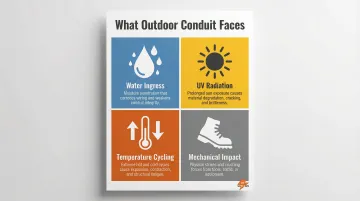
Outdoor conduit faces four primary environmental stressors that indoor raceways never encounter:
- Water ingress: Rain, snow, irrigation runoff, and condensation create persistent wet conditions that seep into any unsealed connection point.
- UV radiation: Direct sunlight degrades non-stabilized plastics over time, causing brittleness and surface cracking that compromise the raceway.
- Temperature cycling: Freeze-thaw cycles in cold climates and rooftop heat extremes stress materials well beyond typical indoor ranges.
- Mechanical impact: Foot traffic, landscaping equipment, and ground movement subject conduit to physical abuse that indoor runs rarely face.
Not all flexible conduit types are listed or rated for these conditions. Installing an indoor-rated product outside can void UL compliance, breach NEC requirements, and cause insulation failure inside the raceway—creating real safety hazards that are far more costly to fix than to prevent.
Types of Flexible Conduit Suitable for Outdoor Use
The NEC governs which conduit types are permitted in wet, damp, or outdoor-exposed locations through Articles 350 (LFMC), 356 (LFNC), and 348 (FMC). Only conduit types specifically listed for outdoor conditions should be selected. Standard FMC and ENT are generally restricted to dry or damp indoor locations. Standard FMC and ENT are generally restricted to dry or damp indoor locations. The four conduit types below cover the full range of outdoor-rated options — from exposed equipment connections to long underground utility runs.
Liquid-Tight Flexible Metal Conduit (LFMC)
LFMC uses a helically wound galvanized steel (or stainless steel, per 2023 NEC updates) stripwound core wrapped in an extruded thermoplastic PVC outer jacket that creates a liquid-tight seal. UL-listed versions may carry a "DIR BURIAL" marking for underground use.
Approved outdoor and wet-location applications include:
- Wet locations, outdoor exposed runs, and HVAC equipment connections
- NEC 350.10(1) explicitly permits LFMC for vibration-mitigation connections in wet locations
- Class I Division 2 hazardous locations when paired with listed fittings
- The thermoplastic jacket resists moisture, UV exposure, and wide temperature swings
- Fittings must also be liquid-tight rated to maintain full system seal integrity
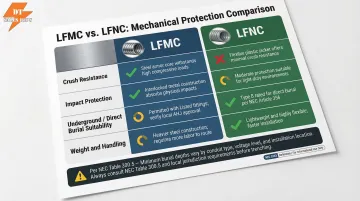
The metal core gives LFMC superior crush and impact resistance — the right call where physical contact or rodent damage is a real concern.
Liquid-Tight Flexible Non-Metallic Conduit (LFNC)
The NEC recognizes two LFNC variants: Type A (flexible PVC reinforced with nylon knit cord between two PVC layers) and Type B (a continuous coil of PVC in a smooth PVC jacket). Both are extruded as liquid-tight and are lighter and more corrosion-resistant than LFMC since there is no metal core.
For outdoor use, LFNC works well for lighting, irrigation system wiring, and signage where a non-metallic system is preferred. Key selection notes:
- Resists moisture, UV (when marked "Sunlight Resistant"), and corrosion
- NEC limits most exposed runs to 6 ft maximum unless otherwise listed
- Confirm the listing label shows "sunlight resistant" for direct sun exposure
Compared to LFMC, it's easier to handle in non-hazardous outdoor applications — though it trades the metal core's crush resistance for lighter weight and corrosion immunity.
HDPE Conduit
High-Density Polyethylene (HDPE) conduit is a heavy-wall thermoplastic conduit available in corrugated flexible and smooth-wall configurations, typically supplied on reels for continuous long runs.
Standard FMC — helically wound galvanized steel or aluminum without a liquid-tight outer jacket — is NOT listed for wet locations or direct outdoor exposure under the NEC. It is not suitable for most outdoor runs.
FMC may be used outdoors only when fully enclosed within weatherproof enclosures that prevent direct moisture exposure. That determination requires sign-off from the Authority Having Jurisdiction (AHJ) and confirmation against the specific UL listing. For any outdoor-rated metal conduit application, LFMC is the correct choice.
Key Factors for Choosing the Right Outdoor Flexible Conduit
Outdoor installations rarely impose a single demand. Most sites combine moisture, UV exposure, and temperature extremes simultaneously—and matching every relevant factor to the conduit's listed rating is what prevents callbacks, rework, and code violations.
Moisture and Liquid Exposure Level
The NEC distinguishes between damp, wet, and submerged/direct burial locations:
- Wet locations: Where water contact is possible (exposed outdoor runs, HVAC equipment connections, irrigation wiring) require wet-listed conduit (LFMC or LFNC)
- Direct burial: Requires the additional "DIR BURIAL" marking on the conduit jacket
The liquid-tight integrity of the full system—conduit, fittings, and connectors—must all be rated for the same condition. A liquid-tight conduit terminated with a non-rated fitting voids the entire system's protection.
UV and Sunlight Resistance
PVC and non-metallic conduit materials can degrade, crack, and become brittle under prolonged UV exposure unless specifically formulated with UV stabilizers. Look for conduit marked "Sunlight Resistant" or "SR" per UL listing, which indicates testing beyond standard PVC formulations.
Comparison:
- LFMC with a PVC jacket typically has better UV resistance than standard LFNC
- LFNC must be specifically marked sunlight resistant for long-term exposed above-ground outdoor runs
- Always verify the sunlight resistance rating on the product label or technical data sheet
Temperature Range
UV resistance addresses surface degradation, but temperature cycles create a separate failure mode. In freeze-thaw climates or high-heat environments like rooftop installations, non-rated conduit can crack in cold or soften and deform in extreme heat.
Verify before specifying:
- Confirm the conduit's listed temperature range matches the installation's expected low and high extremes
- LFMC thermoplastic jacket options (PVC vs. nylon vs. polyurethane) vary in cold-weather flexibility and high-heat tolerance
- In environments below -10°C or above 60°C, check the specific jacket material's rated range against the manufacturer's data sheet
Mechanical Protection and Physical Stress
Temperature resilience matters above ground—below ground, mechanical protection becomes the priority. Outdoor installations face a distinct set of physical hazards:
- Foot traffic and equipment movement
- UV-degraded brittleness over time
- Soil pressure in buried applications
- Rodent damage in underground or concealed runs
LFMC offers better crush and impact resistance than LFNC due to its metal core. For underground installations, consult NEC Table 300.5 for minimum cover requirements by conduit type and location, and confirm the conduit is rated for the burial depth and soil conditions of the specific project.
NEC Compliance and Listing Requirements
NEC Articles 350 (LFMC), 356 (LFNC), and 348 (FMC) define permitted uses, prohibited uses, and installation rules for each conduit type. For outdoor use, verify that the conduit is UL listed and that the UL listing specifically covers the intended condition.
Required markings to check on the conduit jacket:
- "WET" for wet location approval
- "DIR BURIAL" for direct burial approval
- "SUNLIGHT RESISTANT" for UV-stabilized, direct sun exposure
- Hazardous location ratings (e.g., Class I Div. 2) where applicable
These markings are the field-verifiable proof of compliance that AHJs and inspectors rely on.
Conduit Size and Wire Fill Capacity
The NEC fill ratio rule states: for three or more conductors, the combined cross-sectional area of the wires should not exceed 40% of the conduit's interior area (per NEC Chapter 9, Table 1). Overfilling makes pulling wire difficult, creates heat buildup, and can violate code.
When sizing:
- Flexible conduit is available in trade sizes from 3/8 inch to 2 inches (UL listed range)
- Calculate total wire fill based on conductor quantity and gauge
- Choose the next standard size up to maintain the 40% fill margin and allow for future wire additions
Outdoor Application Scenarios: Matching Conduit to the Job
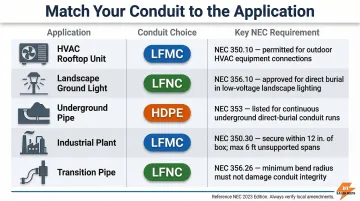
Application environment — not price — is the primary driver of conduit selection outdoors. The five scenarios below map conduit type to real-world conditions, with the NEC requirements that govern each.
| Application | Conduit Choice | Key Requirement |
|---|---|---|
| HVAC & motor connections | LFMC | EGC required where vibration flexibility is needed (NEC 350.60(B)) |
| Landscape, lighting & irrigation | LFNC | Must be marked "Sunlight Resistant"; max 6 ft unless listed otherwise |
| Underground/OSP long runs | HDPE | TIA-758-B governs OSP; reel lengths up to 1,250 ft for HDD |
| Hazardous industrial locations | LFMC or LFNC | Conduit and fittings must both carry hazardous location listings |
| Underground-to-above-grade transitions | HDPE + LFMC | Match trade sizes; use compatible transition fittings from same product family |
HVAC Equipment and Motor Connections Outdoors
Conduit choice: LFMC
Outdoor HVAC units, generators, and industrial motors subject raceways to constant vibration and weather exposure. NEC 350.10(1) permits LFMC for equipment requiring flexibility to mitigate vibration in wet locations. The thermoplastic jacket handles moisture; the metal core absorbs vibration without degrading.
Key requirement: NEC 350.60(B) mandates an equipment grounding conductor where flexibility is necessary to minimize vibration transmission.
Outdoor Lighting, Landscape Wiring, and Irrigation Systems
Conduit choice: LFNC
LFNC is lightweight, corrosion-resistant, and non-metallic — the right fit where a metal raceway isn't required and burial or exposure to soil moisture is a factor.
Key requirement: Verify the LFNC is marked "Sunlight Resistant" and that the installation complies with NEC length restrictions (typically 6 ft maximum unless otherwise listed).
Underground Utility, OSP Fiber, and Long-Run Direct Burial
Conduit choice: HDPE conduit
HDPE is the industry standard for Outside Plant (OSP) telecommunications and utility infrastructure, governed by TIA-758-B. Case studies document Safe Working Pull Strength of 10,472 lbs for 4-inch SDR 13.5 HDPE, with continuous reel lengths up to 1,250 feet — a critical spec for Horizontal Directional Drilling (HDD) installations.
Chemical resistance, crush load tolerance, and reel-length efficiency make HDPE the practical standard for long underground runs and trenchless installations.
Industrial Outdoor Settings — Hazardous Locations
Conduit choice: LFMC or LFNC with hazardous location-rated fittings
In refineries, petrochemical plants, and classified hazardous locations, NEC 501.10(B)(2) permits LFMC and LFNC in Class I Division 2 locations — provided they are installed with listed fittings.
Critical rule: Both the conduit and fittings must carry explicit hazardous location listings. Using general-purpose LFMC without the hazardous location listing in these areas is a code violation.
Hybrid Runs: Underground to Above-Grade Transitions
Application: Transitioning from underground HDPE to above-grade LFMC at equipment termination points
OSP and commercial projects routinely combine underground HDPE runs with above-grade LFMC at equipment termination points. Selecting compatible trade sizes and transition fittings from the same product family simplifies the handoff and maintains system integrity.
How DT Sales Reps Can Help
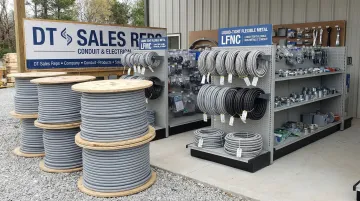
DT Sales Reps supplies conduit, cable, tools, and safety products to electrical and telecommunications distributors across the US. The product range covers every outdoor conduit application, backed by hands-on industry expertise to help distributors and contractors make the right call on every project.
Available products include:
- HDPE conduit for underground OSP runs and direct burial applications
- LFMC and LFNC for above-grade and equipment termination applications
- Microduct for fiber optic cable protection
- Pull boxes for outdoor and wet locations
- Construction tools and safety equipment for jobsite applications
Working with DT Sales Reps also means:
- Sourcing conduit, cable, tools, and safety products from a single supplier — no delays chasing multiple vendors
- Getting code-compliant product recommendations matched to specific outdoor conditions and project specs
- A distributor-focused partner relationship built around on-time, on-budget delivery
If you're a distributor, electrical contractor, or OSP contractor selecting flexible conduit for an outdoor installation, contact DT Sales Reps at 281-900-1506 or DavidS@DTTexas.com to discuss project requirements and product availability.
Conclusion
Choosing flexible conduit for outdoor use goes well beyond material cost. Every installation depends on getting several factors right together:
- Moisture and liquid-tight rating for the exposure environment
- UV resistance for direct sunlight applications
- Temperature range covering both operating and installation conditions
- Mechanical load tolerance for high-traffic or industrial sites
- NEC listing appropriate to the conduit type and application
- Fill capacity sized for current and future wire runs
Miss one, and the rest of the system is at risk.
Requirements shift over time — added equipment, capacity upgrades, or harsher exposure conditions can outpace an installation that was only sized for today. Selecting conduit that meets current conditions while leaving room to grow, and working with a distributor that understands product specs and code requirements, is what keeps a system performing years down the line. DT Sales Reps supplies flexible conduit and related products to contractors and distributors who need reliable materials and informed sourcing support.
Frequently Asked Questions
Can you run wires through flexible conduit?
Yes, flexible conduit is a NEC-defined raceway designed specifically for routing electrical conductors. You pull wires through after installation. Fill ratios must be respected per NEC Chapter 9 — maximum 40% of the interior cross-section for three or more conductors.
Can I put Romex (NM) in flexible conduit?
No, NM cable (Romex) is not permitted inside conduit in most applications. NEC Section 334.15 restricts where NM can be installed, and running it through conduit changes the installation method classification. Use individual THWN or THHN conductors when using conduit as the raceway.
What is the NEC code for flexible conduit?
NEC Article 350 governs Liquid-Tight Flexible Metal Conduit (LFMC), Article 356 covers Liquid-Tight Flexible Non-Metallic Conduit (LFNC), and Article 348 covers Flexible Metal Conduit (FMC). Each article specifies permitted uses, fitting requirements, and wet or outdoor location restrictions for that conduit type.
Can you pull 6 AWG through 3/4 conduit?
It depends on conductor count. A single 6 AWG THHN fits easily in 3/4-inch conduit. For multiple conductors, check NEC Chapter 9 fill tables — total cross-sectional area must stay at or below 40% of the conduit's interior for three or more wires.
What is flexible metal conduit made of?
Standard FMC consists of a helically wound interlocking strip of galvanized steel or aluminum, providing flexibility and mechanical protection. LFMC adds a thermoplastic outer jacket — typically PVC or nylon — over that metal core to create a moisture-resistant seal for wet and outdoor locations.