Introduction
Pick the wrong conduit for an outdoor run and you're looking at UV degradation, water intrusion, or a code violation that shuts the job down. Outdoor electrical conduit isn't a single product — it's a category with meaningfully different options, each suited to specific exposure conditions, burial depths, and load requirements. Choosing incorrectly doesn't just create rework; it creates liability.
This guide covers the different types of outdoor electrical conduit, NEC code requirements, how to choose the right type for above-ground or underground use, and installation details that prevent the most common field errors.
Key Takeaways
- PVC Schedule 40/80 dominates outdoor installations due to corrosion resistance and cost-effectiveness
- NEC Table 300.5 mandates burial depths from 6 inches (RMC) to 24 inches (direct-burial cable)
- Metal conduits (RMC/IMC) provide superior mechanical protection but need corrosion-resistant coatings in wet or buried applications
- HDPE conduit is preferred for long-run underground installations and directional boring
- Outdoor fittings and enclosures must carry wet-location ratings (NEMA 3R or 4X)
What Is Outdoor Electrical Conduit and Why It Matters
Outdoor electrical conduit is a protective tube or raceway designed to encase and route electrical wiring in environments exposed to weather, moisture, UV radiation, and physical stress. Unlike conduit used in dry, indoor locations, outdoor conduit must meet stricter material and installation standards to survive harsh conditions.
Outdoor conduit faces threats that indoor installations never encounter. Freeze-thaw cycles crack rigid materials, direct sunlight degrades plastics, and corrosive soils attack metal — all accelerating conduit failure if the wrong type is selected. The NEC recognizes this reality by requiring wet-location ratings and specific installation methods for outdoor applications.
Outdoor conduit serves three critical functions:
- Protects conductors from external damage (moisture, impact, UV)
- Protects the surrounding environment from electrical hazards
- Prevents moisture migration into buildings and equipment
The NEC distinguishes between damp locations (areas subject to condensation or partial weather protection) and wet locations (underground installations, concrete slabs in contact with earth, or unprotected areas exposed to weather). Misclassifying a location — or ignoring the distinction entirely — is one of the most common reasons outdoor conduit installations fail inspection.
Types of Outdoor Electrical Conduit
No single conduit type is ideal for every outdoor application. The right choice depends on exposure, location (above-ground vs. buried), mechanical stress, and budget. Here are the main categories:
PVC Conduit (Schedule 40 and Schedule 80)
PVC is the most widely used outdoor conduit due to its corrosion resistance, moisture resistance, and low cost. Schedule 40 suits most direct-burial and above-ground applications, while Schedule 80 has thicker walls for greater mechanical protection.
Key specifications:
- 1-inch Schedule 40: 0.133-inch wall thickness
- 1-inch Schedule 80: 0.179-inch wall thickness
- Must be marked "Sunlight Resistant" for above-ground UV exposure
Critical requirements:
- PVC requires a separate bonding/grounding conductor since it's non-conductive
- Expansion fittings needed on runs exceeding 25 feet to handle thermal movement
- PVC expands 3.38 x 10^-5 in/in/°F, meaning a 100-foot run changes over 4 inches with a 100°F temperature swing
- Add 30°F to maximum ambient temperature for direct sunlight exposure
Where to use:
- Schedule 40: Direct burial, protected above-ground runs
- Schedule 80: Exposed above-ground areas subject to physical damage
Metal Conduits (RMC, IMC, and EMT)
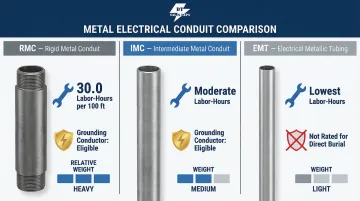
Rigid Metal Conduit (RMC) is the heaviest-duty option—galvanized steel construction that can serve as the equipment grounding conductor. It's ideal for industrial outdoor settings or areas with significant mechanical hazard.
Intermediate Metal Conduit (IMC) is a lighter-weight galvanized steel alternative offering similar protection with reduced installation labor.
Electrical Metallic Tubing (EMT) is thin-wall conduit. Standard EMT is not rated for direct burial and should only be used above-ground in outdoor wet locations with appropriate fittings. The 2023 NEC revised Section 358.10(A)(1) to permit EMT for direct burial if using fittings identified for direct burial—but UL guidelines warn of severe corrosion when galvanized EMT transitions from concrete to soil.
Installation considerations:
- Metal conduits require corrosion-resistant fittings and coatings in wet or coastal environments
- Heavier and more labor-intensive to install than PVC
- 4-inch Rigid Steel requires 30.0 labor-hours per 100 feet, compared to 16.8 hours for Schedule 80 PVC
- Can serve as equipment grounding conductor (RMC and IMC only)
Corrosion warning: Never mix stainless steel fittings with galvanized steel conduit—the stainless acts as a cathode, causing rapid sacrificial corrosion of galvanized components.
Liquidtight Flexible Conduit (LFMC and LFNC)
Liquidtight Flexible Metal Conduit (LFMC) consists of a metal core with a waterproof PVC jacket, suited for outdoor equipment connections that require flexibility—such as HVAC units, motors, and outdoor lighting—where rigid conduit cannot accommodate movement or vibration.
Liquidtight Flexible Nonmetallic Conduit (LFNC) is a lighter, corrosion-resistant alternative suitable for similar applications where metallic strength is not required.
The 6-foot myth debunked: The NEC does not globally restrict LFMC or LFNC to 6-foot maximum lengths. However, per NEC 250.118, flexible conduit can only serve as the equipment grounding conductor if the combined length in the fault path does not exceed 6 feet—beyond that, a separate wire-type grounding conductor is mandatory.
Support requirements:
- LFMC: Every 4.5 feet
- LFNC: Every 3 feet
- Within 12 inches of terminations
HDPE and Fiberglass (RTRC) Conduit
High-Density Polyethylene (HDPE) conduit is the preferred choice for long-run underground installations, common in telecommunications, utility, and OSP (outside plant) projects. HDPE offers superior flexibility, impact resistance, and resistance to soil chemicals compared to PVC—making it well-suited for directional boring and trenchless installation.
Key advantages:
- Manufactured in continuous coilable lengths (reduces joints)
- Exceptional flexibility for trenchless boring
- Superior chemical resistance in corrosive soils
- Lighter weight reduces installation labor
Critical 2023 NEC update: Section 353.48 explicitly prohibits heat fusion or butt fusion joints for HDPE electrical conduit, as fusion creates internal lips that damage cables during pulling.
DT Sales Reps supplies HDPE conduit to distributors and OSP contractors for large-scale underground projects.
Reinforced Thermosetting Resin Conduit (RTRC/fiberglass) is a non-metallic, lightweight option for corrosive outdoor environments such as chemical plants or coastal installations where both metal and standard PVC fall short. RTRC provides exceptional strength-to-weight ratio and is rated for direct burial.
NEC Requirements for Outdoor Electrical Conduit
The National Electrical Code (NEC) governs outdoor conduit installations with strict requirements for wet locations (which includes any outdoor above-ground installation exposed to weather). Understanding these requirements helps electrical contractors and OSP crews spec the right materials from the start and avoid costly rework.
Wet Location vs. Damp Location
Damp Location: Exterior or interior areas subject to periodic condensation — partially protected spaces like canopies or roofed open porches.
Wet Location: Underground installations, conduit in concrete slabs contacting earth, or unprotected locations directly exposed to weather.
All conduit, fittings, and enclosures used in wet locations must be explicitly listed for wet-location use.
Minimum Burial Depth Requirements
NEC Table 300.5 dictates minimum burial depths (cover) for various wiring methods:
| Location/Condition | RMC/IMC | PVC (Sch 40/80) & HDPE | Direct-Burial Cable |
|---|---|---|---|
| Standard trench (earth) | 6 inches | 18 inches | 24 inches |
| Under 2-inch concrete slab | 6 inches | 12 inches | 18 inches |
| Under 4-inch exterior slab (no traffic) | 4 inches | 4 inches | 18 inches |
| Under streets, highways, parking lots | 24 inches | 24 inches | 24 inches |
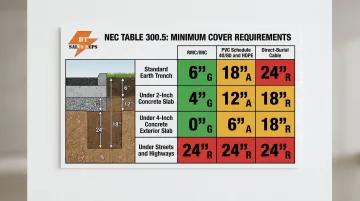
Local codes may require greater depth under driveways or in specific soil conditions.
Wet-Location Fittings and Enclosures
Outdoor conduit fittings, junction boxes, and enclosures must carry wet-location or weatherproof ratings per NEC 314.15. Mismatched fittings are a common code violation.
NEMA ratings for outdoor enclosures:
- NEMA 3R: Protects against rain, sleet, snow — suitable for general outdoor applications
- NEMA 4X: Protects against windblown dust, splashing water, hose-directed water, and passes rigorous 600-hour salt spray testing — required for coastal or highly corrosive environments
Specify NEMA 4X only where the environment genuinely demands it. In standard outdoor conditions, NEMA 3R delivers full protection without the added cost.
Conduit Fill and Ampacity Derating
Conduit fill calculations (NEC Chapter 9) apply outdoors:
- 1 conductor: 53% maximum fill
- 2 conductors: 31% maximum fill
- 3+ conductors: 40% maximum fill
The rooftop temperature penalty: NEC 310.15(B)(2) mandates a 60°F (33°C) ambient temperature adder for raceways installed less than 7/8-inch above a rooftop. Use 4x4 blocks or strut systems to elevate conduits above this threshold. Alternatively, specify XHHW-2 insulated conductors — they're exempt from the adder and can eliminate the need for costly wire upsizing.
Above-Ground vs. Underground Outdoor Conduit
Installation location fundamentally changes what conduit can handle. Above-ground and underground environments expose conduit to completely different stresses — and the wrong choice fails fast.
Above-Ground Conduit Requirements
Above-ground conduit must withstand:
- UV degradation (requires sunlight-resistant rating)
- Physical impact (Schedule 80 PVC or RMC in high-traffic areas)
- Temperature swings (thermal expansion fittings for PVC)
- Direct weather exposure (wet-location rated fittings)
NEC-approved options: PVC Schedule 40/80 (UV-stabilized), RMC, IMC, EMT (with weatherproof fittings), LFMC, LFNC, RTRC
Underground Conduit Requirements
Underground conduit must resist:
- Soil chemicals and corrosive elements
- Moisture intrusion and standing water
- Soil pressure and settling
- Freeze-thaw cycles
Installation methods:
- Direct burial in a trench — the standard approach for single runs
- Concrete duct bank — preferred for high-voltage or multi-circuit runs where future cable access matters
Underground conduit must be sealed at all building and enclosure entry points using sealing fittings or duct seal compound. This blocks moisture migration and pest intrusion per NEC 225.27, 230.8, and 300.5(G).
Approved types: PVC Schedule 40/80, HDPE, RMC, IMC, RTRC. Standard EMT is not recommended for direct burial — despite the 2023 NEC allowing it, corrosion risk makes it a poor long-term choice.
How to Choose the Right Outdoor Conduit for Your Project
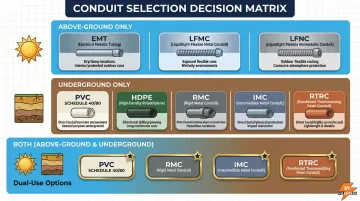
Step 1: Above-Ground or Underground?
This single question eliminates several options immediately:
- Underground only: PVC Schedule 40/80, HDPE, RMC, IMC, RTRC
- Above-ground only: EMT (not for burial), LFMC, LFNC
- Both: PVC Schedule 40/80, RMC, IMC, RTRC
Step 2: Evaluate Environmental Exposure
- UV intensity: PVC must be sunlight-resistant rated for above-ground exposure
- Standing water/chemical exposure: HDPE or PVC for direct-burial in wet soils; RTRC for highly corrosive environments
- Temperature extremes: Account for thermal expansion in PVC (expansion fittings on runs exceeding 25 feet)
- Coastal/high-humidity: Use NEMA 4X enclosures; avoid mixing stainless and galvanized metals; consider PVC or RTRC over standard metal conduit
Step 3: Assess Mechanical Protection Needs
Above-ground conduit in areas subject to physical damage requires:
- Schedule 80 PVC (not Schedule 40)
- RMC or IMC (not EMT)
- Proper support spacing per NEC requirements
Step 4: Consider Budget and Labor
Material cost hierarchy: PVC Schedule 40 < PVC Schedule 80 < EMT < IMC < RMC
Labor cost reality: Metal conduit installation requires significantly more labor. 4-inch Galvanized Rigid Conduit requires 30.0 labor-hours per 100 feet, compared to just 16.8 hours for Schedule 80 PVC. In areas subject to physical damage where metal was traditionally the default, pivot to heavy-wall nonmetallics like Schedule 80 PVC or RTRC to cut installation costs.
Step 5: Source from Reliable Suppliers
For contractors and distributors sourcing conduit at scale—particularly for multi-run underground or OSP projects—supplier selection matters as much as material selection. DT Sales Reps supplies HDPE, PVC, microduct, pull boxes, and related accessories to distributors and contractors, with product expertise specific to underground and OSP applications.
Outdoor Conduit Installation Best Practices
Getting installation right the first time prevents costly rework, failed inspections, and safety hazards. The requirements differ significantly between above-ground and underground runs, so both are covered below.
Above-Ground Installation Essentials
Use weatherproof components:
- Conduit bodies and fittings rated for wet locations
- NEMA 3R or 4X enclosures
- Seal all wall penetrations with appropriate conduit sealant
Support at proper intervals:
| Conduit Type | Max Spacing |
|---|---|
| EMT | 10 feet |
| RMC/IMC | 10 feet (20 feet for vertical threaded runs) |
| PVC (1/2" to 1") | 3 feet |
| PVC (1-1/4" to 2") | 5 feet |
| LFMC | 4.5 feet |
Thermal expansion: Use expansion fittings on PVC runs exceeding 25 feet. For direct sunlight exposure, add 30°F to your maximum ambient temperature before calculating expansion — sun-baked conduit runs hotter than the air around it.
Underground Installation Essentials
Underground runs follow different rules — burial depth, bedding, and sealing are all regulated and inspected. Get these right before backfilling.
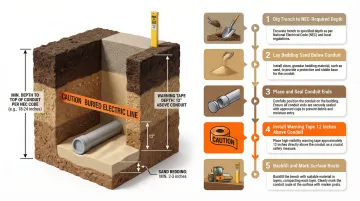
Trench depth: Follow NEC Table 300.5 minimum cover requirements for your conduit type and location.
Bedding and backfill:
- Use bedding sand around conduit to prevent damage from sharp rocks
- For concrete duct banks, use lean concrete between conduit layers for rigidity and thermal conductivity
- Install warning tape 12 inches above conduit and 12 inches below finished grade
- Seal conduit ends before backfilling to block moisture and debris intrusion
- Mark the conduit route with warning tape or surface markers for future excavation safety
Common Installation Mistakes to Avoid
- Using non-weatherproof boxes in wet locations
- Failing to secure flexible conduit at required intervals (every 4.5 ft for LFMC; every 3 ft for LFNC)
- Mixing incompatible fitting materials (steel fittings on aluminum conduit causing galvanic corrosion)
- Neglecting to pull a grounding conductor through non-metallic conduit
- Using heat fusion joints on HDPE electrical conduit — the 2023 NEC prohibits this joining method for electrical applications specifically
- Exceeding conduit fill percentages
- Ignoring thermal expansion on long PVC runs
Frequently Asked Questions
What are the requirements for outdoor electrical conduit?
Outdoor conduit must be listed for wet locations per the NEC, installed at correct burial depths per NEC Table 300.5 for underground runs, and paired with weatherproof-rated fittings and enclosures (NEMA 3R or 4X). Specific requirements vary by conduit type and installation method.
Which type of conduit is best for outdoor and wet locations?
PVC Schedule 80 and LFMC are top choices for above-ground wet locations, while PVC Schedule 40 and HDPE are preferred for underground installations. Your best option comes down to location (above-ground vs. buried) and the level of mechanical protection required.
Is PVC conduit suitable for outdoor use?
Yes, PVC conduit is suitable for outdoor use when it is UV-stabilized (sunlight-resistant rated) for above-ground exposure, or Schedule 40/80 for direct burial. A separate grounding conductor must be included since PVC is non-conductive.
Can EMT conduit be used outdoors?
EMT works in outdoor above-ground wet locations with weatherproof fittings. While the 2023 NEC technically permits direct burial, it is not recommended in practice due to severe corrosion risk. In corrosive or coastal environments, PVC-coated or stainless EMT may be required.
How deep does outdoor electrical conduit need to be buried?
NEC Table 300.5 minimum cover requirements: typically 6 inches for RMC/IMC, 18 inches for PVC Schedule 40/80, and 24 inches for direct-burial cable without conduit. Local codes may require greater depth under roads or driveways—always verify with your jurisdiction.