

Introduction
Pull boxes, conduit runs, and cable pulls put hands in constant contact with sharp edges, solvents, and abrasive surfaces — yet hand protection is often the last thing crews think about until something goes wrong. According to the Bureau of Labor Statistics, private industry employers reported 2.5 million nonfatal workplace injuries in 2024, with upper extremities being the most frequently affected body part in days-away-from-work injuries. Wrist injuries alone led to 15 median days away from work; hand injuries accounted for 5.
Standard 3–4 mil exam gloves simply aren't built for this environment. They fail quickly against oils, solvents, and abrasive surfaces, which drives up both injury risk and replacement costs.
For electrical contractors, OSP crews, and construction teams burning through high glove volumes per shift, heavy-duty disposables offer better protection and lower cost-per-use. This guide covers the key specs, materials, and top options worth stocking in 2025.
Key Takeaways
- Heavy-duty industrial gloves are typically 6–8 mil thick nitrile with strong puncture and chemical resistance
- Nitrile dominates industrial applications due to oil/solvent resistance and latex-free composition
- Key selection criteria: mil thickness, ANSI/ISEA ratings, grip texture, and AQL defect tolerance
- Top 2025 picks include Venom Steel, Ammex GWON, and Kimberly-Clark KleenGuard G10
- Bulk purchasing through a B2B distributor like DT Sales Reps reduces per-unit costs and keeps crews stocked without delays
Why Heavy-Duty Disposable Gloves Are a Jobsite Essential
A disposable glove qualifies as "heavy-duty" in industrial contexts when it meets specific performance thresholds: typically 6 mil thickness or greater, with documented resistance ratings for puncture, chemicals, and abrasion. This separates them from standard exam or food-service gloves, which are designed for lighter-duty tasks.
Using the wrong glove on industrial jobsites creates two primary risks:
- Worker injury from glove failure — A glove that tears mid-task exposes hands to chemicals, cuts, or abrasions
- Inflated costs from high replacement rates — Cheap gloves that fail every 20 minutes cost more per shift than premium gloves that last the full task
Electrical contractors, OSP contractors, and construction crews—the teams that rely on suppliers like DT Sales Reps for jobsite essentials—burn through dozens of pairs per worker per day. Frequent glove failures mean downtime, re-gloving delays, and real injury exposure. For procurement, that shifts the evaluation from price-per-glove to cost-per-completed-task.

Best Heavy Duty Disposable Gloves for Industrial Work 2025
These gloves were evaluated for mil thickness, puncture and chemical resistance ratings, grip performance, material quality, and durability under industrial conditions.
Venom Steel Rip-Resistant Industrial Nitrile Gloves
Venom Steel's Rip-Resistant line uses dual-layer nitrile construction built for demanding jobsite conditions — a strong fit for construction and mechanical trades.
Key differentiators:
- Dual-layer nitrile resists tears on sharp edges and rough surfaces
- 9.5-inch extended cuff covers the wrist during forearm-exposure tasks
- Full-texture surface holds grip on wet and oily surfaces
These features matter specifically in construction and mechanical environments where gloves encounter sharp edges, rough surfaces, and petroleum-based substances throughout the shift.
| Spec | Detail |
|---|---|
| Material & Thickness | Dual-layer nitrile; 6 mil |
| Key Protection Features | Puncture-resistant, extended cuff, fully textured grip; powder-free |
| Best Industrial Application | Heavy mechanical work, oil/grease handling, demolition tasks |
Ammex GWON Industrial Nitrile Gloves
For high-volume procurement in chemical-heavy environments, the Ammex GWON is a practical choice. At 8–9 mil thickness, it runs heavier than most industrial disposables and ships in case quantities suited for large facility operations.
Key differentiators:
- 8 mil palm / 9 mil finger thickness outlasts most industrial disposables in continuous-use environments
- Powder-free construction eliminates contamination risk in sensitive areas
- Ships 100 gloves per box, 10 boxes per case — built for facility-scale restocking
| Spec | Detail |
|---|---|
| Material & Thickness | Heavy-duty nitrile; 8 mil palm / 9 mil finger |
| Key Protection Features | Powder-free, chemical barrier, textured grip, beaded cuff; AQL 4.0 |
| Best Industrial Application | Chemical plant work, facility maintenance, manufacturing floor use |
Kimberly-Clark KleenGuard G10 2PRO Nitrile Gloves
Where the Ammex GWON prioritizes raw thickness, the KleenGuard G10 2PRO targets consistent chemical protection across large crews — backed by an AQL 1.5 defect tolerance that's significantly tighter than the AQL 4.0 standard for most industrial gloves.
Key differentiators:
- 6-mil finger thickness balances chemical protection with tactile sensitivity
- Ambidextrous fit speeds up gloving and reduces dispensing waste on large crews
- ASTM-tested chemical resistance with verified barrier performance against industrial chemicals
- AQL 1.5 defect tolerance — tighter than the AQL 4.0 typical of industrial-grade gloves
This is a practical choice for safety managers sourcing for large contractor or construction crews who need reliable, consistent performance at scale.
| Spec | Detail |
|---|---|
| Material & Thickness | Nitrile; 6 mil finger |
| Key Protection Features | Chemical barrier (EN ISO 374-1 Type B), ambidextrous, powder-free, AQL 1.5 |
| Best Industrial Application | Large crew jobsites, construction, chemical exposure tasks |
Ansell TouchNTuff 92-600 Nitrile Gloves
The Ansell TouchNTuff 92-600 is purpose-built for solvent, oil, and hazardous substance exposure. It's one of the few disposable nitrile options with published chemical permeation breakthrough times — a critical data point for chemical plant and hazmat-adjacent roles.
Key differentiators:
- Published permeation test data covers heptane, sodium hydroxide, formaldehyde, and hydrogen peroxide
- Smooth powder-free interior supports comfort during extended wear
- AQL 1.5 defect tolerance with EN ISO 374-1 Type B certification for chemical barrier performance
| Spec | Detail |
|---|---|
| Material & Thickness | Nitrile; 0.12 mm palm / 0.14 mm finger (approximately 4.7–5.5 mil) |
| Key Protection Features | EN 388:2016 Level 1 abrasion, EN ISO 374-1 Type B JKPT, extended beaded cuff, AQL 1.5 |
| Best Industrial Application | Chemical handling, solvent exposure, hazardous material contact tasks |
Note: While the TouchNTuff 92-600 falls slightly below the 6-mil threshold, its documented chemical resistance and AQL 1.5 defect tolerance make it a strong choice for chemical-specific applications where permeation resistance matters more than mechanical thickness.
How to Choose the Right Heavy-Duty Disposable Glove for Industrial Work
Mil Thickness: The Primary Selection Variable
For most industrial applications, 6 mil is the minimum floor. Here's what thickness means in practical terms:
- 6 mil — Suitable for chemical handling tasks where chemical resistance rating is strong, light mechanical work, and general industrial use
- 8 mil — Recommended for tasks involving repeated friction, sharp surfaces, heavy mechanical work, and extended wear
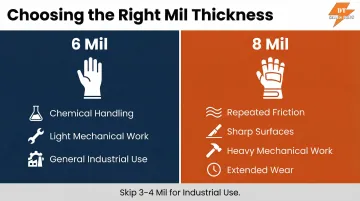
Skip 3–4 mil gloves for industrial use — the cost savings don't justify the risk.
Material Selection: Why Nitrile Dominates
Nitrile outperforms both latex and vinyl for industrial applications:
- Allergy-safe (no latex proteins)
- Superior oil, solvent, and chemical resistance
- Better puncture resistance than either alternative
Vinyl isn't a viable substitute, even at lower cost — it lacks the chemical resistance and durability that jobsite hazards demand.
According to OSHA publication 3151, nitrile gloves "stand up to heavy use even after prolonged exposure to substances that cause other gloves to deteriorate. They offer protection when working with oils, greases, acids, caustics and alcohols."
ANSI/ISEA Ratings and AQL Standards
ANSI/ISEA 105-2024 provides a uniform system for classifying glove performance:
- Cut Resistance: Rated A1 (200–499 grams) to A9 (≥6000 grams)
- Puncture Resistance: Rated Level 0 (<10 Newtons) to Level 5 (≥150 Newtons)
- Abrasion Resistance: Rated 0 to 6
AQL (Acceptance Quality Limit) defines the maximum percentage of defective units acceptable in a batch:
- AQL 1.5 — Maximum 1.5% defective units (premium standard)
- AQL 4.0 — Maximum 4.0% defective units (typical industrial standard)
For critical tasks, specify AQL 1.5. For high-volume, lower-risk applications, AQL 4.0 is acceptable — and will keep per-unit costs down without compromising safety at that exposure level.
OSHA Guidance on Hand Protection
Under 29 CFR 1910.138, OSHA requires employers to "base the selection of the appropriate hand protection on an evaluation of the performance characteristics of the hand protection relative to the task(s) to be performed, conditions present, duration of use, and the hazards and potential hazards identified."
In practice, that means no specific brand or mil thickness is mandated — the obligation is hazard matching. For chemical and puncture hazards in industrial settings, nitrile is the standard choice that satisfies that requirement.
Grip and Cuff Design: Practical Selection Factors
Grip texture:
- Textured fingertips work for light oil and grease environments
- Full-texture surface is necessary in heavy oil, grease, or wet conditions
Cuff length:
- Standard 9.5-inch cuff covers most tasks
- Extended 10–12 inch cuff is needed when wrist and forearm exposure is a risk — chemical splashing and immersion work in particular
How We Selected These Gloves
These gloves were assessed based on:
- Mil thickness — 6 mil minimum for heavy-duty classification
- Published ANSI/ISEA or ASTM test ratings — Verified performance data, not marketing claims
- Grip texture for industrial conditions — Tested for oil and wet-surface performance
- Brand reputation and quality control standards — AQL ratings and manufacturing consistency
- Fit for high-volume procurement — Availability in bulk case quantities for distributors and large crews
Understanding what separates a solid glove from a liability also means knowing where buyers go wrong.
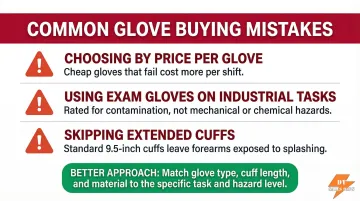
Common Mistakes Buyers Make
- Price per glove: A $0.10 glove that fails every 20 minutes costs more per shift than a $0.25 glove that lasts two hours.
- Medical-grade exam gloves on industrial tasks: Exam gloves are rated for contamination barriers, not mechanical or chemical hazards — they tear quickly on jobsites.
- Skipping extended cuff options: Tasks involving chemical splashing or forearm exposure require 10–12 inch cuffs. Standard 9.5-inch cuffs leave forearms exposed.
Conclusion
The right heavy-duty disposable glove for industrial work comes down to matching the specific hazard—chemical, puncture, abrasion, or oil/grease—to the appropriate mil thickness, material, and grip configuration. Defaulting to the cheapest per-glove price is a false economy when glove failure doubles both labor and material cost.
Procurement managers and safety buyers should assess glove performance at scale: a glove that fails mid-task forces workers to re-glove, disrupts workflow, and increases injury risk. Quality-per-case is a smarter metric than cost-per-glove.
That same logic applies across your entire jobsite supply chain. DT Sales Reps supplies safety products alongside conduit, cable, and tools for distributors, construction companies, and electrical contractors — so sourcing PPE doesn't have to mean a separate vendor relationship.
If you're sourcing heavy-duty gloves alongside conduit, cable, and tool needs, contact DavidS@DTTexas.com or call 281-900-1506 to simplify your procurement process.
Frequently Asked Questions
What are the best heavy duty disposable gloves for industrial work in 2025?
Heavy-duty nitrile gloves in the 6–8 mil range are the top category for industrial work. Leading options include Venom Steel Rip-Resistant (6 mil), Ammex GWON (8 mil), and Kimberly-Clark KleenGuard G10 2PRO (6 mil), all offering strong puncture resistance, chemical protection, and durability under real industrial conditions.
What are the best heavy duty work gloves?
For disposable options, 6–8 mil nitrile with textured grip is the standard for industrial settings. Reusable gloves (leather, cut-resistant fabric) are better for extreme cut or impact protection, while disposables excel in chemical and contamination environments.
What gloves does OSHA recommend for industrial work?
OSHA (29 CFR 1910.138) does not mandate specific brands but requires employers to select gloves appropriate to the chemical, abrasion, or puncture hazard present. Heavy-duty nitrile meets the requirements for most industrial chemical and mechanical hazard applications, given its resistance to oils, solvents, and puncture.
What mil thickness is best for industrial disposable gloves?
6 mil is the minimum for industrial use, with 8 mil recommended for heavy mechanical work, sharp surfaces, or extended chemical exposure. Thinner gloves (3–4 mil) are not appropriate for most industrial applications and should be reserved for light-duty or exam-grade tasks only.
Are heavy-duty nitrile disposable gloves chemical resistant?
Yes, nitrile resists oils, solvents, fuels, and many industrial chemicals — but performance varies by substance and contact duration. Always verify the manufacturer's chemical resistance chart and breakthrough time data for your specific hazard.
How often should disposable gloves be changed during industrial work?
Change gloves immediately upon visible damage, puncture, or contamination. For chemical tasks, follow the manufacturer's permeation breakthrough time data — elevated temperatures and movement can reduce breakthrough times by 20% or more, so err toward more frequent changes in those conditions.