Introduction
Steel fabrication floors present a perfect storm of hand hazards: arc heat reaching 6,500°F at the weld pool, molten spatter flying in every direction, razor-sharp sheared plate edges, and grip forces required to maneuver heavy structural steel. A standard work glove—or even a light-duty MIG glove—won't survive the first hour on a structural steel floor.
The stakes are real. According to the Bureau of Labor Statistics, Fabricated Metal Product Manufacturing recorded 3.2 total recordable injury cases per 100 full-time workers in 2024—hand injuries among the most common. With dozens of gloves marketed as "heavy-duty," choosing the wrong spec wastes money and risks lost-time injuries that average $47,316 per workers' compensation claim.
This guide evaluates five welding gloves purpose-built for steel fabrication in 2025, provides a clear breakdown of what to look for, and explains how to source reliably through distributors who understand the difference between lab ratings and jobsite performance.
Key Takeaways
- Steel fabrication gloves must handle sustained heat, spatter, cut hazards, and abrasion — requirements far beyond light-duty MIG gloves
- Five gloves reviewed: elkskin, split cowhide, pigskin/cowhide hybrid, and deerskin builds for Stick, MIG, flux-core, and structural work
- Select by leather grade, cuff length, heat resistance rating, and how much dexterity the task demands
- Stick and structural welding: use gauntlet cuffs (5"+) and thick grain leather; MIG and flux-core allow lighter grain gloves with better finger feel
- DT Sales Reps stocks vetted welding safety products for bulk procurement, so teams can specify a glove and receive it consistently
Why Steel Fabrication Demands More from Welding Gloves
Steel fabrication stacks multiple hazard layers at once: arc heat at the weld pool (6,500°F per Lincoln Electric's technical documentation), UV/IR radiation, metal spatter, sharp sheared or plasma-cut plate edges, and the grip forces needed to position heavy plate. That's a more demanding combination than most light-duty shop welding ever produces.
The numbers reflect it. The Bureau of Labor Statistics reports that Fabricated Metal Product Manufacturing recorded 3.2 total recordable cases and 1.8 DART (Days Away, Restricted, or Transferred) cases per 100 full-time workers in 2024—among the higher injury rates in skilled trades.
Three Primary Glove Use Cases in Steel Fab Shops
Each task in a steel fab shop presents a distinct hazard profile:
- Active structural welding (Stick/SMAW, FCAW on heavy plate): Demands maximum heat and spatter resistance. Per the American Welding Society, high-amperage FCAW and pulsed GMAW require heavier-duty gloves with melt-through resistance—standard leather isn't enough.
- MIG/wire-feed tacking and fitting: Calls for a dexterity-protection balance. Workers operate trigger mechanisms continuously, so back-of-hand heat protection can't come at the cost of finger mobility.
- Material handling between welds: Requires cut resistance and secure grip on raw steel. Plasma-cut and sheared edges create mechanical hazards that most standard welding gloves aren't rated to handle.
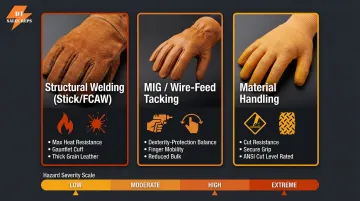
Most workers need at least two glove types to cover these distinct hazard profiles safely and efficiently.
Top 5 Heavy-Duty Welding Gloves for Steel Fabrication in 2025
Each glove below was selected on material quality, heat and spatter protection, cuff design, and real-world feedback from fabrication environments. Pricing reflects current availability through established safety distributors.
Tillman 750 Top Grain Elkskin Welding Gloves
The Tillman 750 is built specifically for MIG, Stick, and structural tack welding on heavy steel. Its top grain elkskin outer shell resists cracking and stays pliable under sustained heat — a common failure point with cheaper cowhide gloves.
A sewn-in cotton foam lining handles thermal insulation, while the reinforced palm and thumb saddle hold up against plate handling abrasion during long fabrication shifts.
| Key Features | Heat & Protection Rating | Best For / Pricing |
|---|---|---|
| Top grain elkskin outer shell; Kevlar stitching; cotton/foam lined back with unlined palm; welted fingers; reinforced thumb; 14" length | Not explicitly rated to ANSI/ISEA 105 or EN 12477 standards; proprietary construction designed for high-heat pipeline stick welding | Pipeline stick welding, high-heat structural applications; $40–$66 per pair |
Lincoln Electric K2979 Heavy Duty Welding Gloves
The Lincoln Electric K2979 is built for heavy-duty fabrication, with an extra-long 5" gauntlet cuff that protects the forearm during overhead and positional structural welding. Heavy shoulder split cowhide and a full sock cotton liner deliver sustained heat insulation where it matters most.
The K2979 performs particularly well in high-spatter SMAW/FCAW work, where hands move closer to the arc as the electrode is consumed.
| Key Features | Heat & Protection Rating | Best For / Pricing |
|---|---|---|
| Shoulder split cowhide; 3-ply Kevlar stitching; full sock cotton liner; 5" cuff (14" total length); welted seams; additional thumb pad | Not explicitly rated; designed for sustained heat exposure in Stick, flux-core, MIG, and pulsed MIG applications | Stick/FCAW on structural steel, overhead welding; $22–$27 per pair |
Miller Electric Heavy Duty MIG/Stick Welding Gloves
The Miller Electric Heavy Duty glove handles both MIG tacking and heavier Stick runs. Its hybrid construction — pigskin palm with cow split back and cuff — balances abrasion resistance with breathability across extended shifts.
Pre-curved fingers reduce hand fatigue, while double-layered foam/cotton fleece lining adds thermal insulation without making the glove stiff or unwieldy.
| Key Features | Heat & Protection Rating | Best For / Pricing |
|---|---|---|
| Pigskin grain palm; cow split back/cuff; Kevlar thread; double-layered foam/cotton fleece lining; pre-curved fingers; wing thumb; strategic reinforcement patches; 14" length | Not explicitly rated; proprietary construction designed for heavy-duty MIG/Stick applications | Heavy-duty MIG/Stick welding on structural steel; $37–$42 per pair |
Caiman 1878 American Deerskin MIG Welding Gloves
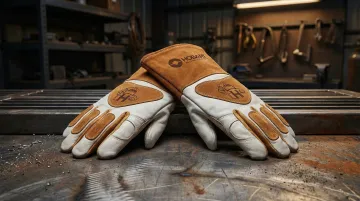
The Caiman 1878 uses American split deerskin leather — a material that stays naturally soft and heat-resistant without the stiffness that causes fatigue in tight-clearance work. It's the right pick for fabricators who need protection without sacrificing tactile feel.
The sock-lined FR cotton fleece/foam construction and extended 21" gauntlet cover MIG, Stick, overhead, and plasma applications well. Note: the 1878 is not the right call for the heaviest continuous Stick/FCAW duty cycles.
| Key Features | Heat & Protection Rating | Best For / Pricing |
|---|---|---|
| Genuine American split deerskin; Kevlar thread; sock-lined FR cotton fleece/foam; 21" gauntlet; leather heat shield patch; reinforced palm/cuff | Not explicitly rated; designed for MIG, Stick, overhead, and plasma applications where dexterity is critical | MIG/precision fab work, overhead welding, plasma cutting; $44–$97 per pair |
West Chester IRONCAT 6020 MIG Welding Gloves
The West Chester IRONCAT 6020 is a reliable heavy-duty MIG option for structural steel fabrication environments. Split cowhide construction holds up to sustained MIG work and light Stick applications without the premium price tag of deerskin alternatives.
Note: the IRONCAT 4020 SKU maps to a PVC-coated general-purpose glove — not a welding glove. The 6020 is the correct heavy-duty welding equivalent in the IRONCAT lineup.
| Key Features | Heat & Protection Rating | Best For / Pricing |
|---|---|---|
| Split cowhide outer shell; cotton lining; reinforced palm and thumb; gauntlet cuff; Kevlar stitching; 14" length | Not explicitly rated; designed for sustained MIG and light Stick applications in fabrication environments | Structural steel MIG welding, light Stick work; $18–$28 per pair |