Introduction
Picture this: a contractor finishes a landscape lighting installation, backfills the trench, and collects payment—only to get called back three months later because the circuit is dead. When the box is excavated, it's filled with muddy water, the wire nuts are corroded green, and the connections have failed completely. The culprit? A standard weatherproof box never rated for underground use, combined with improper sealing at the conduit entries. The result: excavation costs, failed inspection, and a client who won't call back.
Underground electrical failures are preventable. The 2024 Common Ground Alliance DIRT Report documented 196,977 utility damage incidents across all underground infrastructure — and improper installation practices are a recurring driver of rework across electrical trades.
This guide is for electrical contractors, construction crews, and OSP contractors who need to get it right the first time. You'll learn how to select junction boxes with the correct submersion ratings, size them properly per NEC requirements, and install them so they stay dry and accessible for decades.
TLDR:
- Use only NEMA 6/6P or IP67/IP68 rated boxes underground — weatherproof boxes will fail
- Seal every conduit entry with listed compounds or watertight hubs
- Follow NEC Table 300.5 for burial depth (18–24 inches for conduit, typically)
- Keep lids at or above grade per NEC 314.29 accessibility requirements
- Use UL 486G direct-burial connectors inside the box — never standard wire nuts
What Is an Underground Electrical Junction Box and When Do You Need One?
Defining Underground Junction Boxes
An underground (direct-burial or in-grade) electrical junction box is an enclosure designed to protect electrical connections from soil pressure, moisture intrusion, and prolonged contact with groundwater. Unlike standard surface-mounted or above-ground boxes, these enclosures must withstand constant exposure to wet conditions and physical loads from the earth above them.
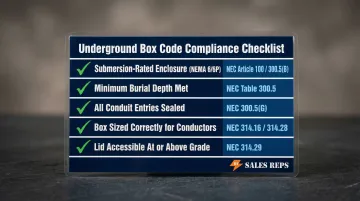
The National Electrical Code is explicit on this point. NEC Article 100 classifies underground installations as "Location, Wet," and NEC 300.5(B) states that enclosure interiors installed underground are considered wet locations. Every component—box, conductors, and connectors—must be listed for wet or direct-burial use.
Common Applications Requiring Underground Boxes
Those code requirements translate directly to the field. Underground junction boxes are mandatory for:
- Landscape lighting circuits connecting multiple fixture runs
- Irrigation system wiring for valve controllers and pump connections
- Outdoor power feeds to detached garages, sheds, or outbuildings
- Direct-burial conduit runs requiring splice points or direction changes
- Telecom and OSP infrastructure for fiber optic and data cable management
Weatherproof vs. Waterproof: A Critical Distinction
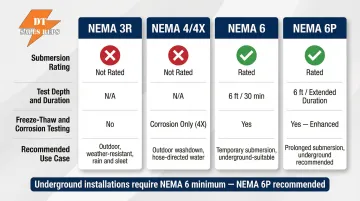
Not every outdoor box qualifies for underground use. A box marked "weatherproof" or rated NEMA 3R is designed only to shed rain and resist surface moisture—it will fail rapidly when buried. True underground boxes must be rated for submersion: NEMA 6/6P or IP67/IP68. Confusing these ratings is one of the most common—and costly—specification errors on buried electrical projects.
How to Choose the Right Waterproof Underground Junction Box
Understanding NEMA and IP Ratings for Submersion
Selecting the correct enclosure starts with understanding protection ratings:
NEMA 4/4X: Designed for above-grade outdoor use, these boxes resist windblown dust, rain, and hose-directed water (tested at 65 GPM for 5 minutes). They are not submersion-rated and will fail underground.
NEMA 6: Provides protection against occasional temporary submersion—tested at 6 feet depth for 30 minutes. Suitable for areas with intermittent water exposure.
NEMA 6P: Provides protection against prolonged submersion—tested at 6 feet depth for 24 hours. This is the gold standard for underground installations where water saturation is inevitable.
IP Ratings: The International Protection (IP) code uses a two-digit system. IP67 indicates dust-tight protection and temporary submersion resistance (up to 1 meter for 30 minutes). IP68 indicates prolonged submersion capability.
Critical difference: IP68 and NEMA 6P are not interchangeable. NEMA 250 includes additional tests for corrosion resistance, gasket aging, and external icing that IP ratings skip entirely. For underground environments with freeze-thaw cycles or corrosive soils, specify NEMA 6P.
Enclosure Materials and Load-Bearing Capacity
Once you've confirmed the protection rating, material selection comes down to what's above the box — and how heavy it gets.
Material Options:
- PVC/Polycarbonate: Lightweight, corrosion-resistant, suitable for residential landscape lighting. Typically rated for pedestrian traffic only (3,000-5,000 lbs test load per ANSI/SCTE 77).
- Fiberglass (FRP): More durable than PVC, handles moderate loads. Suitable for sidewalks and light commercial applications (Tier 8: 12,000 lbs test load).
- Polymer Concrete: High strength-to-weight ratio, excellent chemical resistance. Ideal for driveways and parking areas (Tier 15/22: up to 33,750 lbs test load).
- Precast Concrete with Steel Frame: Maximum durability for roadway installations requiring AASHTO H-20 rating (40,000 lb proof load on a 9"x9" plate).
Traffic Rating Standards:
ANSI/SCTE 77 applies to non-deliberate traffic (sidewalks, driveways, parking lots). AASHTO H-20 is legally required for boxes installed in direct wheel paths on streets and highways. Installing a Tier 15 or Tier 22 box in a roadway puts the enclosure, the conductors inside, and anyone nearby at risk — these ratings simply aren't built for vehicle axle loads.
Box Sizing: NEC 314.16 and 314.28 Requirements
Undersizing junction boxes is a common and costly code violation.
For conductors 6 AWG and smaller (NEC 314.16): Calculate required box volume by counting:
- Each conductor entering the box
- Each device yoke (counts as two conductors)
- All equipment grounding conductors combined (count as one)
Multiply each count by the volume allowance for that wire gauge — for example, 12 AWG requires 2.25 cubic inches per conductor.
For conductors 4 AWG and larger (NEC 314.28): Sizing shifts to dimensional rules:
- Straight pulls: Box length must be at least 8 times the trade diameter of the largest conduit.
- Angle or U pulls: Distance from conduit entry to opposite wall must be at least 6 times the largest conduit diameter, plus the sum of all other conduit diameters on that wall.
Conduit Entry Compatibility and Sealing
The junction box must accept the conduit type you're running — PVC Schedule 40/80, HDPE, or rigid metal — with properly sized knockouts or threaded hubs.
Sealing is non-negotiable. NEC 300.5(G) requires all conduit entries to be sealed against moisture. A correctly rated NEMA 6P box will still fail if entries are left open or improperly sealed.
Sealing methods:
- Watertight hubs with integral BUNA-N O-ring seals (UL 514B listed)
- Closed-cell urethane foam sealants (e.g., Polywater FST, capable of holding 22 feet of water head pressure)
Component compatibility matters at the sourcing stage. DT Sales Reps carries HDPE conduit, PVC conduit, pull boxes, and matching fittings — sourcing from a single distributor reduces the risk of mismatched parts showing up on the job.
Lid and Locking Mechanism Requirements
Lids must be bolt-down or screw-secured to maintain the enclosure's waterproof rating. For installations under driveways or roads, specify traffic-rated (T-rated) lids designed to withstand vehicle loads without cracking.
The lid must also allow re-entry without damaging the gasket or seal—critical for meeting NEC 314.29 accessibility requirements.
Step-by-Step Installation Guide
Step 1: Site Preparation and Depth Determination
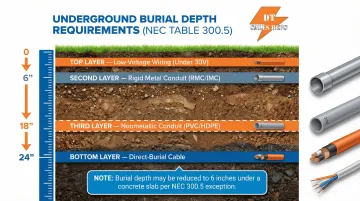
Before breaking ground, determine the correct burial depth using NEC Table 300.5:
- Direct-burial cables: 24 inches under general conditions, 18 inches under concrete slabs
- Nonmetallic conduit (PVC/HDPE): 18 inches under general conditions, 12 inches under concrete
- Rigid metal conduit (RMC/IMC): 6 inches under general conditions
- Low-voltage landscape/irrigation wiring (<30V): 6 inches minimum
Always call 811 at least 48-72 hours before digging. The 2024 CGA DIRT Report found that "Failure to notify 811" was the #1 root cause of utility strikes, accounting for 24.54% of all incidents—35,402 damages in a single year.
Step 2: Excavation and Bedding
Dig the hole 6-8 inches larger than the box footprint on all sides. Prepare a level bed of crushed gravel or coarse sand at the bottom—this provides drainage and prevents the box from settling unevenly.
Set the box so the lid sits at or just below finished grade. Per NEC 314.29, the lid must remain accessible, and a lid positioned below grade becomes a collection point for surface water. Once the box is level and seated correctly, route your conduit runs into the box.
Step 3: Conduit Routing and Entry Sealing
Route conduit runs into the box through properly sized knockouts. Use the correct fittings for your conduit type:
- PVC Schedule 40/80: Use threaded adapters or compression fittings with O-ring seals
- HDPE: Use mechanical couplings or fusion-compatible fittings only — NEC 353.48 prohibits heat fusion joints between HDPE conduit and box fittings
Apply listed sealing compound or foam at each entry point. This is the most common water ingress failure point—do not skip it.
Step 4: Making Connections Inside the Box
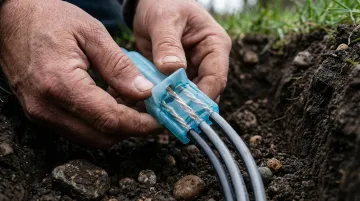
Use only wire connectors rated for direct burial (UL 486G listed). Standard "wet location" wire nuts (UL 486D) are designed for above-grade splash protection and will fail underground.
Approved direct-burial connectors:
- IDEAL UnderGround 60/64 (gel-filled)
- 3M DBR/Y-6 Direct Bury Splice Kit
- King Innovation DryConn
Critical installation warning: Do not pre-twist wires before inserting them into gel-filled connectors. Pre-twisting prevents the silicone gel from fully encapsulating the copper, allowing moisture infiltration and corrosion.
Step 5: Lid Installation and Backfilling
Secure the lid per manufacturer specifications, torquing bolts evenly to maintain gasket compression. Backfill in 6-inch compacted layers to prevent box shift or settlement.
Mark the box location per local code requirements—many jurisdictions require surface markers or documentation for future reference.
Step 6: Testing Before Burial
Perform a continuity check on all circuits. For added assurance, use a megohmmeter (insulation resistance tester) to verify cable integrity. ANSI/NETA ATS-2017 recommends a 1000V DC test yielding at least 100 Megohms for 600V-rated cables.
Any wiring faults caught at this stage can be fixed in minutes. The same repair after backfill means excavating the entire trench.
NEC Code Compliance and Safety Requirements
Key NEC Articles Governing Underground Boxes
| NEC Article | Scope | Practical Requirement |
|---|---|---|
| 300.5 | Underground wiring methods | Sets minimum burial depths and mandates physical protection for conductors |
| 314.29 | Box and handhole accessibility | Lid must remain at or above finished grade; no excavation required to reach connections |
| 314.28 | Box sizing | Size based on conductor count and wire gauge — undersizing causes heat buildup and fails inspection |
The Accessibility Rule Explained
NEC 314.29(B) requires that underground boxes remain accessible without excavation. That means a field inspector, utility crew, or contractor must be able to open the box and access splices or terminations at any point after installation — without breaking concrete or moving earth.
Exception: Listed boxes may be covered by gravel, light aggregate, or noncohesive granulated soil, provided their location is effectively identified and accessible for excavation.
Listed Equipment Requirement
All enclosures, connectors, and sealing materials used underground must be UL-listed or listed by another Nationally Recognized Testing Laboratory (NRTL) for wet or direct-burial locations. Non-listed components routinely fail inspection — and since the box is already buried by that point, the rework cost (excavation, re-termination, re-burial) far exceeds the cost of specifying listed equipment from the start.
Common Mistakes to Avoid
Using Non-Submersible Boxes Underground
NEMA 3R and standard weatherproof boxes are designed to shed rain—they are not watertight and will fail when buried. Once soil moisture reaches the connections inside, corrosion and ground faults follow quickly.
Skipping Conduit Entry Sealing
Even a correctly rated NEMA 6P box fails if conduit entries aren't sealed. Open knockouts or improperly sealed entries are the primary water infiltration path. Always use listed sealing compound or watertight hubs at every conduit entry.
Setting the Box Too Deep or at an Angle
A box buried below grade (where the lid sits under soil) violates NEC 314.29 accessibility requirements and creates a water collection point. Surface water pools at the lid and seeps in over time. Always confirm final lid elevation matches finished grade before backfilling.
Skipping Drainage in Condensation-Prone Areas
A sealed-bottom box without drainage in condensation-prone areas will fill with water over time. Buried conduits act as thermal straws — hot, humid above-ground air is pulled into cool underground pipes, where it condenses and drips into the box.
Where permitted, the fix is straightforward:
- Use an open-bottom pull box instead of a sealed-bottom enclosure
- Set it over at least 6 inches of pea gravel to allow condensation to drain into the earth
Frequently Asked Questions
Can a junction box be buried underground?
Yes, junction boxes can be buried underground, but only if they are specifically rated and listed for direct burial or submersion (NEMA 6/6P or IP67/IP68). Standard or weatherproof boxes will fail rapidly when exposed to soil moisture and groundwater.
Are electrical junction boxes waterproof?
Not all junction boxes are waterproof. Outdoor boxes may be weatherproof (splash-resistant), but underground applications require submersion-rated enclosures. Always verify the NEMA or IP rating on the product label before purchase.
What is the minimum depth for a buried electrical junction box?
NEC Table 300.5 sets burial depth based on circuit voltage and wiring method. For direct-burial cable, the minimum is typically 24 inches under general conditions and 18 inches under concrete slabs. Always confirm local code requirements with your Authority Having Jurisdiction (AHJ).
What NEMA rating do I need for an underground junction box?
Underground boxes should meet at minimum NEMA 6 (submersion up to 6 feet for 30 minutes) or NEMA 6P for prolonged submersion. NEMA 4X is suitable only for above-grade waterproof applications and will fail if buried.
Can I use PVC or HDPE conduit with an underground junction box?
Yes, both PVC Schedule 40/80 and HDPE conduit are compatible with underground junction boxes when correct fittings are used. Use listed, properly sized hubs or fittings — sealed to maintain the enclosure's waterproof rating.
How do I prevent water from entering a buried junction box?
Three practices keep water out:
- Specify a submersion-rated enclosure (NEMA 6/6P or IP67/IP68)
- Seal every conduit entry with listed sealing compound or watertight fittings
- Set the box level with the lid at or above finished grade so water drains away from the seal
Need conduit, pull boxes, or underground installation materials? DT Sales Reps supplies electrical contractors and distributors with HDPE conduit, PVC conduit, traffic-rated pull boxes, and the fittings you need to ensure compatibility and code compliance. Contact David S at DavidS@DTTexas.com or 281-900-1506 for pricing and availability.