

Introduction
Hand injuries represent a significant safety challenge in the construction industry. According to the CPWR Construction Chart Book (7th edition, 2025), injuries to hands alone account for 16.4% of all nonfatal construction injuries, ranking third among the most common causes of days away from work—right behind trunk and back injuries. Many of these incidents are preventable with proper hand protection.
On construction sites, disposable gloves create a barrier against chemical burns from wet concrete, solvents, and adhesives—while also blocking cuts and contaminants. Unlike reusable coated gloves, disposables let crews swap gloves between tasks without carrying contamination from one material to the next. That matters when the same worker handles epoxy adhesive and then moves to precision wiring work.
This guide covers the top disposable gloves for construction use, what to look for when buying, and how to choose the right type for the task at hand.
Key Takeaways
- Nitrile disposable gloves provide the best balance of chemical resistance, durability, and grip for construction
- Look for 6–8 mil gloves for heavy tasks; 4 mil works for finishing or electrical precision work
- Key factors: grip texture, puncture resistance, powder-free design, OSHA compliance
- Concrete work requires alkali resistance; electrical work demands dexterity—match glove specs to the task
- Buy in bulk from a reliable supplier to keep crews stocked and costs predictable
Why Disposable Gloves Belong on Every Construction Site
Disposable gloves create a critical barrier against chemical burns from wet concrete (pH 12–14), solvents, and adhesives while protecting against cuts and contaminants. They also enable quick task changes without the cross-contamination risks that come with reusable gloves, which matters when crews rotate between chemical handling and precision work.
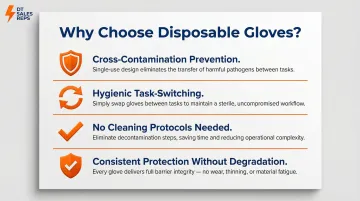
Key advantages over reusable coated gloves:
- Prevent cross-contamination between chemical handling and clean tasks
- Enable hygienic task-switching in high-rotation crew environments
- Eliminate the need for cleaning and maintenance protocols
- Provide consistent protection without degradation from repeated washing
Compliance is also a practical concern. OSHA standard 29 CFR 1910.138 requires employers to provide hand protection when hazards are present, and 29 CFR 1910.132(d) mandates a formal hazard assessment covering chemical exposure, punctures, and abrasions. Construction sites are further governed by 29 CFR 1926 Subpart E. For non-cut-hazard tasks, properly selected disposable nitrile gloves satisfy these requirements.
Best Disposable Gloves for Construction Work
These picks were evaluated for durability, grip, chemical resistance, and suitability for real construction site conditions. Options are organized from heaviest-duty protection down to precision-task gloves — match the glove to the job at hand.
Gloveworks HD Orange Raised Diamond Texture Nitrile Gloves
The AMMEX Gloveworks HD Orange (GWON) is purpose-built for demanding industrial applications including construction, painting, and chemical handling. This glove stands out in jobsite environments where grip on tools and slick surfaces is critical.
Key differentiators:
- Raised diamond texture pattern on palm and fingers for superior grip
- Ultra-thick 8 mil nitrile construction for heavy-duty protection
- Powder-free and latex-free design
- Extended cuff for wrist protection
- FDA 21 CFR 177.2600 certified and manufactured under ISO 9001:2015
| Specification | Details |
|---|---|
| Material & Thickness | 8 mil nitrile (9 mil at fingertips) |
| Key Features | Raised diamond texture grip, powder-free, latex-free, puncture-resistant, extended cuff |
| Best Construction Use Case | Painting, chemical handling, tool work, plumbing on jobsites |
Glovezilla 8.5 Mil Nitrile Gloves
Glovezilla represents one of the thickest disposable nitrile options on the market, built with a 2-ply construction process that delivers heavy-duty durability without sacrificing dexterity. Originally designed for automotive and industrial use, it crosses over well for construction demolition and debris handling.
Why it works on jobsites:
- 8.5 mil thickness with dual-layer manufacturing
- Raised diamond texture grip for secure tool handling
- Black color masks grease, concrete staining, and debris
- High puncture resistance suited for demolition debris and sharp-edged materials
| Specification | Details |
|---|---|
| Material & Thickness | 8.5 mil nitrile, 2-ply construction |
| Key Features | Raised diamond grip, high puncture resistance, latex-free, black color |
| Best Construction Use Case | Demolition work, debris handling, heavy mechanical tasks on construction sites |
AMMEX Black Nitrile Industrial Gloves (6 Mil)
AMMEX's 6 mil black nitrile option is a crew-ready workhorse used across construction, industrial, and facility maintenance applications. This glove strikes the balance between protection and finger dexterity, making it ideal for general construction tasks.
Standout features:
- 6 mil thickness balances protection with tactile sensitivity
- Black color masks staining from concrete and adhesives
- Powder-free and latex-free formulation
- Available in high-volume case packs ideal for large construction crews
- Textured fingertips for improved grip
| Specification | Details |
|---|---|
| Material & Thickness | 6 mil nitrile |
| Key Features | Powder-free, latex-free, black color, textured fingertips, high-volume availability |
| Best Construction Use Case | General construction tasks, concrete work, adhesive and sealant handling |
Kimberly-Clark Purple Nitrile Exam Gloves
Kimberly-Clark's Purple Nitrile gloves are a precision-grade disposable option. While thinner at approximately 6 mil, they are exam-grade certified and valued on construction sites for electrical work and finishing tasks where tactile sensitivity matters more than heavy protection.
Construction-specific advantages:
- Excellent tactile sensitivity for precision work
- Beaded cuff for controlled removal
- AQL 1.0-1.5 quality testing standard
- Passes ASTM D6978-05 for specialized chemical resistance
- Widely stocked by safety distributors, making reordering straightforward for crews
| Specification | Details |
|---|---|
| Material & Thickness | Approximately 6 mil nitrile |
| Key Features | Beaded cuff, AQL quality testing, high dexterity, powder-free, latex-free |
| Best Construction Use Case | Electrical work, trim and finishing tasks, light chemical exposure on construction sites |
Microflex Mega Texture Nitrile Gloves
Microflex (an Ansell brand) is a trusted name in industrial hand protection. The Mega Texture 93-283 is engineered with a unique diamond-pattern surface that maintains grip even in wet or oily conditions common on active construction sites.
What sets it apart:
- Diamond-pattern grip surface tested for wet and dry conditions
- Longer cuff for wrist protection
- Textured through the palm for secure tool handling
- Latex-free nitrile formulation
- 9.4 mil finger thickness for enhanced durability
| Specification | Details |
|---|---|
| Material & Thickness | 9.4 mil nitrile (fingertips) |
| Key Features | Diamond-pattern grip, extended cuff, powder-free, wet-condition tested |
| Best Construction Use Case | Wet concrete work, roofing, surface prep tasks involving solvents or coatings |
Matching the Right Glove to Your Construction Task
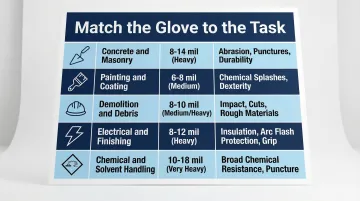
Different construction tasks demand different glove specifications. The table below maps common jobsite tasks to the right spec — use it as a quick reference when ordering for a crew.
| Task | Recommended Spec | Why It Matters |
|---|---|---|
| Concrete & masonry | 6–8 mil nitrile, alkali-resistant | Wet portland cement reaches pH 12–14 and can cause chemical burns; verify resistance to calcium hydroxide in the manufacturer's TDS |
| Painting & coating | 6–8 mil nitrile, diamond/raised-texture grip | Textured surface prevents slippage on paint-covered tools while blocking solvent permeation |
| Demolition & debris | 8+ mil nitrile, dual-layer construction | Higher tear and puncture resistance for sharp edges and rough surfaces |
| Electrical & finishing | 6 mil nitrile | Thinner profile preserves dexterity for precision work — note: standard disposable nitrile carries no electrical insulation rating; never use for live-wire tasks |
| Chemical & solvent handling | 6–8 mil nitrile with ASTM F739 permeation data | ASTM F739 measures chemical breakthrough time; cross-check the TDS against your specific solvents before ordering |
Crew-Wide Procurement Strategy
Rather than stocking one mid-range glove for every task, carry two options: a heavy-duty 6–8 mil for site work and a lighter 4–6 mil for electrical and finishing. This reduces both failure rates and glove waste — and typically costs less per project than relying on a single compromise spec.
How to Choose the Best Disposable Gloves for Construction
Avoid the Price-Per-Box Trap
The most common purchasing mistake is buying based on price per box alone without accounting for mil thickness. This leads to high tear-through rates, more frequent glove changes, and higher total cost. Calculate cost-per-use, not cost-per-glove.
Example: A $15 box of 4 mil gloves that requires 3 gloves per task costs more per task than a $25 box of 8 mil gloves that uses 1 glove per task.
Key Technical Specifications
Mil Thickness:
- 4–6 mil for light-duty finishing and precision work
- 6 mil for general construction tasks
- 8+ mil for heavy-duty demolition and debris handling
While mil thickness is a useful indicator, it's not a formal standard. Performance also depends heavily on material quality and brand-specific formulation.
Grip Texture:
- Raised diamond texture performs best on slick or wet surfaces
- Standard micro-texture works for dry, general construction tasks
- Smooth finish — avoid for construction; grip on tools is insufficient
Powder-Free and Latex-Free: Both Required
Powder residue contaminates adhesives, coatings, and electrical components — creating compliance and quality problems beyond simple comfort concerns. Powder-free gloves are the right default for construction environments.
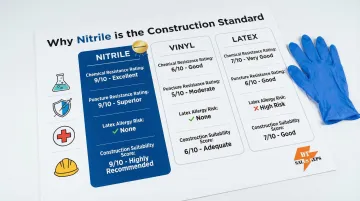
Latex allergies affect an estimated 8–12% of frequently exposed occupational groups. On mixed crews, that's a real safety liability. Nitrile is the standard recommendation: latex-free protection with better chemical resistance than vinyl.
Source Through a Reliable Supplier
Once you know what specs to look for, consistent supply matters as much as the right product. For large crews, a supplier who stocks bulk quantities and fulfills reliable reorders keeps compliance from slipping between orders. DT Sales Reps stocks disposable gloves alongside conduit, cable, tools, and other jobsite essentials — giving distributors and contractors a single source for consolidated procurement.
Conclusion
Choosing the right disposable glove affects crew productivity, OSHA hand protection compliance, and jobsite safety in ways that add up quickly across a project.
Before settling on a single glove type, assess your specific jobsite tasks, crew size, and glove turnover rate. A two-tier approach (heavy-duty + precision) often delivers better outcomes than buying a single type for every task.
Ready to stock your construction crew or distributor network with the right disposable gloves? Contact DT Sales Reps at 281-900-1506 or DavidS@DTTexas.com to discuss bulk procurement options and ensure your teams have the protection they need to work safely and efficiently.
Frequently Asked Questions
What are the best disposable work gloves?
Nitrile gloves are the top choice for construction and industrial work due to their superior chemical resistance, puncture resistance, and durability compared to vinyl or latex alternatives. Mil thickness should match task intensity: 6–8 mil for heavy construction, 4–6 mil for precision work.
What gloves does OSHA recommend?
OSHA standard 29 CFR 1910.138 requires hand protection selected to match the specific hazards present. For construction chemical and puncture hazards, nitrile gloves meeting ASTM performance standards are typically the compliant choice.
Which disposable gloves are the strongest?
8+ mil nitrile gloves (such as dual-layer options like Glovezilla at 8.5 mil) are the strongest disposable options available. 2-ply construction and higher mil thickness provide significantly greater puncture and tear resistance than standard 4–6 mil gloves.
Are disposable gloves enough protection for construction work?
Disposable nitrile gloves cover chemical, concrete, and light puncture hazards well, but they are not a substitute for cut-resistant or impact gloves when working with sharp tools, heavy materials, or machinery. Match the glove type to the specific task hazard.
What mil thickness should I use for construction gloves?
Use 6–8 mil for general and heavy construction tasks where durability is the priority, and 4–6 mil for precision or electrical work where dexterity matters more. Going too thin for heavy tasks dramatically increases glove failure rates and per-task cost.
Can nitrile gloves be used for electrical work on a construction site?
Standard disposable nitrile gloves carry no electrical insulation rating — OSHA requires voltage-rated rubber insulating gloves for live electrical work. Nitrile disposables are appropriate only for chemical handling or non-energized task work in electrical environments.