Introduction
Contractors and procurement teams face a persistent challenge: finding reliable construction tools that fit tight budgets. Choosing the wrong tools—whether buying low-quality equipment that fails mid-project or overspending on heavy-duty gear for light-duty jobs—derails timelines, inflates costs, and creates safety hazards.
With 65% of construction professionals citing inflation as a top budget concern, the pressure to maximize every dollar spent on tooling has never been higher.
This guide gives you a clear framework for making smarter tool purchasing decisions. You'll learn which tool categories are genuinely essential, which budget-friendly brands deliver proven performance, and how to evaluate durability and warranty terms—not just sticker price. We'll also cover how sourcing tools alongside conduit, cable, and safety gear from a single distributor like DT Sales Reps can simplify procurement and reduce costs across ongoing projects.
Key Takeaways
- Reputable mid-range tool brands cover light-to-medium construction tasks effectively — the key is matching tool grade to job scope, not chasing the lowest price tag
- Build your tool inventory around project requirements: prioritize hand tools and fastening gear first, then layer in cordless power tools as job complexity grows
- Standardizing on a single battery platform across cordless tools eliminates redundant charging systems and reduces per-tool operating costs
- Evaluate warranty coverage, parts availability, and material durability — not just price
- Sourcing tools, conduit, and safety products through a single distributor reduces procurement friction and consolidates per-unit costs across the jobsite
Why Affordable Construction Tools Matter for DIY Projects
The DIY home improvement market has exploded as economic pressures mount. The U.S. hardware stores industry reached $45.2 billion in revenue in 2025, with the broader home improvement market forecast to hit $688 billion by 2029. Contractors and tradespeople feel this pressure directly — tool budgets get scrutinized on every project, and the line between cost-effective and cheap matters.
The cost risk cuts both ways. A $15 no-name drill that strips out mid-framing wastes more money than it saves in delays and rework alone. But overspecifying tools for the job is equally wasteful — a crew running occasional drywall installs doesn't need the same drill spec as a production framing operation running eight hours a day.
Today's affordable brands have closed the quality gap significantly for light-to-medium construction tasks — framing, electrical rough-in, drywall, and decking. Head-to-head testing shows that Craftsman's V20 circular saw ripped through double-stacked OSB in 20.22 seconds, matching pro-tier speeds. The key is matching the tool to the task—and knowing where budget tools hit their limits.
Must-Have Tool Categories for DIY Construction Projects
Before evaluating brands, understand which tool categories are truly essential. Organize your budget into two groups: hand tools (lower cost, foundational) and power tools (higher impact per dollar for specific tasks).
Hand Tools (The Non-Negotiable Foundation)
Every DIY construction kit needs these core hand tools:
- 16 oz. framing hammer – Drives nails, pulls fasteners, and handles demolition work
- 25 ft. tape measure – Layout, measurements, material sizing
- Utility knife: Cuts drywall, insulation, packaging, and shingles
- Adjustable wrench – Plumbing, hardware assembly, bolt work
- Combination pliers – Gripping, twisting, pulling wire and fasteners
- Flathead and Phillips screwdrivers – Assembly, electrical work, hardware installation
- Torpedo level: Ensures plumb and level on framing, shelving, and fixtures
A $55 hand tool set with a lifetime warranty will outlive five $15 no-name kits — quality hand tools last decades.
Specialized electrical and conduit tools:
For DIY electrical rough-in and conduit work, add:
- Lineman's pliers
- Wire strippers
- Fish tape
- Conduit benders
These are essential for running wire, bending conduit, and pulling cable through walls. Trade-focused suppliers often stock these alongside conduit materials for one-stop procurement.
Power Tools (Highest ROI for DIY Builds)
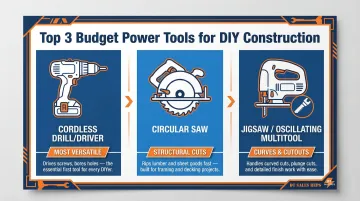
The top 3 budget power tools that deliver the broadest utility:
Cordless drill/driver – The most versatile tool on any jobsite. Drives screws, drills holes, and handles everything from framing to drywall installation.
Circular saw – Handles structural cuts in lumber, plywood, and OSB for framing, decking, and subfloor work. Choose cordless for portability or corded for sustained heavy-duty cutting.
Jigsaw or oscillating multitool – Jigsaws handle curves and interior cutouts like sink openings and electrical boxes; oscillating tools excel at flush cuts and tight-space demo work.
Corded vs. cordless:
| Cordless | Corded | |
|---|---|---|
| Portability | Full freedom of movement | Limited by cord length |
| Power | Sufficient for most tasks | Consistent for heavy-duty use |
| Cost strategy | Standardize on one 18V or 20V platform | Lower upfront tool cost |
| Best for | Most jobsite scenarios | Sustained stationary cutting |
Standardizing on a single battery platform — where batteries are interchangeable across tools from the same brand — reduces overall cost across a crew's tool inventory.
Safety and Jobsite Essentials
No tool budget is complete without basic safety gear:
- Work gloves
- Safety glasses
- Hearing protection
- Hard hat (for structural work)
Sourcing these from a jobsite essentials supplier that also offers tools, conduit, and cable — such as DT Sales Reps, which stocks tools, conduit, cable, and safety gear for contractors and distributors — can simplify procurement and reduce costs.
Top 5 Budget-Friendly Construction Tool Brands for DIY Projects
Not every tool purchase needs to break the budget. These five brands earned their spots based on price-to-performance ratio, warranty terms, real-world user reviews, and suitability for light-to-medium construction tasks — from basic home repair to electrical rough-in work.
Ryobi
Ryobi leads the DIY power tool market with one of the broadest cordless ecosystems available — its ONE+ 18V platform spans 300+ tools on a single shared battery. Buy one battery and charger, then add bare tools as needed. It's a cost-effective way to build out a full toolkit over time.
Differentiators:
- Widest cordless ecosystem in the budget category
- Consistent beginner-friendly ergonomics
- Widespread availability at major home improvement retailers
- 3-year limited warranty on power tools and batteries
| Feature | Details |
|---|---|
| Price Range | Entry-level drill kit: $49.97; 1/2" drill with 515 in-lbs torque: $89.00; 2-tool combo: $149.00; 4-tool combo: $249.00 |
| Best For | Homeowners and DIY beginners tackling framing, decking, furniture assembly, and general home improvement |
| Warranty | 3-year limited warranty on power tools and batteries |
Black+Decker
Black+Decker is a household name in entry-level power and hand tools, particularly popular with first-time DIYers and light construction users. The brand emphasizes ease of use, compact form factors, and low price of entry.
Differentiators:
- Lightweight designs ideal for overhead or confined-space work
- Frequent combo kit bundles that provide multiple tools at a fraction of individual pricing
- Broad accessory compatibility
- 2-year limited warranty for home use
| Feature | Details |
|---|---|
| Price Range | 68-piece drill and home tool kit: $99.00; 4-tool combo kit: $164.80 |
| Best For | Light construction, home repairs, small renovation tasks, and first-time tool buyers |
| Warranty | 2-year limited warranty for home use |
Craftsman
Craftsman has been a trusted American tool brand since 1927, historically known for its lifetime warranty on hand tools and solid mid-range power tool performance. Now under Stanley Black & Decker, the brand continues to offer reliable tools at accessible prices for serious DIY builders.
Differentiators:
- Strong hand tool lineup (wrenches, ratchets, screwdrivers) with lifetime guarantee
- Growing cordless V20 platform with 100+ tools
- Competitive combo kit pricing
- Identified as the most trusted hand tool brand in 2026
| Feature | Details |
|---|---|
| Price Range | V20 1/2" drill kit: $69.00; V20 2-tool combo kit: $99.00; 57-piece hand tool set: $54.57-$62.98 |
| Best For | DIY builders and weekend contractors who need durable hand tools and a reliable cordless power tool platform |
| Warranty | 3-year limited warranty on V20 power tools; Full/Limited Lifetime on hand tools |
Klein Tools
Few brands carry the trade credibility that Klein Tools has built since 1857. Klein dominates hand tools for electrical work — lineman's pliers, wire strippers, screwdrivers, and levels — built to professional standards at prices individual buyers can manage. That makes Klein the practical first choice for electricians, OSP contractors, and DIYers tackling electrical rough-in work.
Differentiators:
- Tools built to trade-professional standards at prices accessible to individual buyers
- Consistently rated No. 1 in the electrical trade
- EC&M Product of the Year winner and NECA Showstopper Award recipient
- Normal life of the product warranty
| Feature | Details |
|---|---|
| Price Range | 6-piece apprentice tool set: $99.97; 9" lineman's pliers: $34.99; wire stripper (11045): $16.97 |
| Best For | Electrical contractors, OSP contractors, and DIYers working on wiring, conduit installation, and panel work |
| Warranty | Normal life of the product; returns processed through authorized Klein Tools distributors with Warranty Return Authorization (WRA) number |
WEN
WEN offers one of the broadest corded and cordless tool lineups in the under-$100 price range, covering drills, saws, sanders, and lathes. Price points regularly undercut Ryobi and Black+Decker, making WEN a strong fit for DIY projects where tools see occasional rather than daily use.
Differentiators:
- Pricing often undercuts Ryobi and Black+Decker while maintaining respectable performance for intermittent use
- Particularly strong in stationary tools (bench drills, band saws) that are otherwise expensive
- 2-year limited warranty for personal/home use (90 days for commercial use)
| Feature | Details |
|---|---|
| Price Range | 20V Max 3/8" drill kit (354 in-lbs torque): $52.99; 7.25" corded track saw: $151.03 |
| Best For | Budget-constrained DIYers doing occasional light construction, woodworking, or home repair projects |
| Warranty | 2-year limited warranty for personal/home use (customer prepays shipping for warranty service) |
How to Choose the Right Budget Construction Tools
The most common mistake buyers make is shopping by price alone. The smarter approach is to evaluate tools by cost-per-use (how many times the tool will realistically be used) and task-specificity (whether a cheaper version can handle the actual forces, materials, and conditions of the project).
Battery Platform Compatibility
Commit to a single brand's battery ecosystem before buying your first cordless tool. Mixing platforms means paying for redundant batteries, which quickly erases the savings from buying budget tools.
Choosing a brand with a wide platform—like Ryobi's ONE+ with 300+ compatible tools—future-proofs your investment. Buy the drill kit with battery and charger today, then add bare tools (circular saw, jigsaw, impact driver) later without buying more batteries.
Material and Build Quality Signals
What to look for physically when evaluating budget tools:
- Metal gear housings vs. all-plastic – Metal gears last longer under torque
- Rubberized grips – Better control and comfort during extended use
- Torque/amperage specs relative to the task – A 354 in-lbs drill struggles with lag bolts; a 515 in-lbs drill handles them easily
- Manufacturer country of production – Not always a dealbreaker, but can indicate quality control standards
These details are often the difference between a tool that lasts 3 years and one that lasts 10.
Warranty and Parts Availability
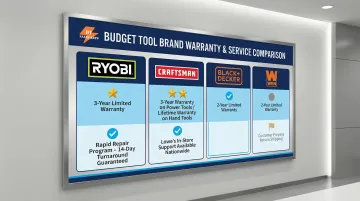
A warranty is only valuable if the brand backs it. Ryobi offers a "Rapid Repair" program where users print a free FedEx label and have tools repaired within 14 business days. Craftsman leverages Lowe's retail footprint for easy in-store support. WEN requires customers to prepay shipping for warranty service.
For contractors running multi-phase projects, warranty turnaround time is a real cost—a tool out for repair during active framing or rough-in work stalls the whole crew. Weigh that risk when choosing between brands at similar price points.
Where to Source Tools and Jobsite Essentials Together
For contractors and distributors managing construction projects at scale, sourcing tools alongside conduit, cable, and safety gear from a single supplier cuts down on purchase orders, vendor coordination, and delivery lead times.
DT Sales Reps supplies construction tools as part of a broader catalog built for jobsite needs:
- Construction tools and hand tools
- HDPE conduit, PVC, and microduct
- Pull boxes and cable
- Safety equipment and OSP products
Consolidating orders through a single supplier with responsive service keeps procurement straightforward and projects moving forward.
Conclusion
Sourcing affordable construction tools without sacrificing performance comes down to a few consistent decisions. Whether you're a contractor stocking a crew or a distributor building out your product mix, the same principles apply:
- Match tool categories to your actual job scope — avoid over-speccing for tasks that don't warrant it
- Choose brands with compatible battery platforms and solid warranties to reduce long-term replacement costs
- Work with suppliers who deliver value beyond the product itself: availability, lead times, and knowledgeable support
Ready to source tools, conduit, and safety products for your next job site? Electrical contractors, OSP contractors, distributors, and construction teams can reach out to DT Sales Reps at 281-900-1506 or DavidS@DTTexas.com for tools, conduit, cable, safety products, and jobsite essentials—delivered on time and on budget.
Frequently Asked Questions
What tools do I need to start a DIY construction project on a budget?
Start with core hand tools: hammer, 25 ft. tape measure, combination pliers, flathead and Phillips screwdrivers, utility knife, and torpedo level. For power tools, invest in one quality cordless drill/driver kit first, the most versatile tool you'll own. This starter approach keeps initial spend under $150 while covering 80% of basic construction tasks.
Is it worth buying cheap power tools for DIY construction?
Budget power tools from reputable brands like Ryobi, Black+Decker, and WEN are genuinely capable for light-to-medium construction tasks. However, extremely low-cost no-name tools often lack the torque, durability, and safety certifications needed for safe use on real construction work. Stick with established brands that offer warranties and replacement parts.
What is the difference between corded and cordless tools for DIY projects?
Corded tools deliver consistent power for sustained heavy-duty tasks and cost less upfront, but limit your movement. Cordless tools offer portability ideal for most DIY scenarios — and if budget allows, investing in a quality battery platform gives you the most flexibility across jobs.
Which affordable tool brand is best for electrical and conduit work?
Klein Tools is the industry standard for affordable electrical hand tools, offering lineman's pliers, wire strippers, fish tape, and conduit benders built to trade-professional standards. Sourcing these through a trade-focused distributor like DT Sales Reps can offer better pricing than retail for contractors managing larger scopes of work.
How much should I budget for a basic DIY construction tool kit?
A realistic starter kit budget runs $104 to $154: a 65-piece hand tool set (around $55) plus a Ryobi cordless drill kit ($49.97) or a Craftsman V20 2-tool combo ($99.00). Seasonal promotions at Home Depot and Lowe's often bundle extra batteries at these price points.
Can I buy construction tools and safety gear from the same supplier?
Yes. DT Sales Reps, for example, supplies construction tools alongside safety equipment (helmets, gloves, jobsite signs), HDPE conduit, PVC, cable, and pull boxes — all under one roof. Consolidating procurement through a single supplier simplifies ordering and reduces overall project costs.