Introduction
PVC conduit runs terminate at metal junction boxes, outlet boxes, and panel enclosures on nearly every commercial and residential job. The catch: connecting them isn't straightforward. PVC cannot be glued directly to metal, so the transition requires specific adapter fittings designed for the purpose.
This connection introduces a unique grounding consideration: PVC is non-conductive, so the metal box's grounding continuity must be maintained separately. This guide covers every step, fitting choice, and NEC compliance requirement involved in making a code-compliant PVC-to-metal box connection.
Key Takeaways
- PVC conduit connects to metal boxes using a threaded PVC male terminal adapter and locknut—no solvent cement at the metal interface
- A separate equipment grounding conductor (EGC) must run through the conduit per NEC 352.60
- Proper knockout sizing and locknut torque prevent the most common installation failures
- Insulating bushings are required by NEC 300.4(G) for 4 AWG and larger conductors to protect wire insulation from sharp metal edges
- Confirm knockout diameter matches conduit trade size before final assembly to avoid loose fittings or rejected inspections
What You Need Before Getting Started
The adapter type you need depends on your conduit schedule (Schedule 40 vs. Schedule 80) and trade size — getting these right before the job starts prevents errors and keeps you code-compliant.
Equipment and Fittings
- PVC male terminal adapter (sized to match conduit trade size)
- Metal box locknut
- Insulating bushing (recommended for all installations, required for 4 AWG and larger)
- PVC conduit of the correct schedule
- Equipment grounding conductor (bare copper or green-insulated)
Tools Required
- Conduit cutter or hacksaw
- Deburring tool or reamer
- Adjustable pliers or channel-locks
- Screwdriver
- Tape measure
- Marker for layout
DT Sales Reps supplies PVC conduit, pull boxes, cable, and jobsite essentials to distributors — everything on this list available through a single source.
Solvent cement and primer apply only to PVC-to-PVC joints earlier in the run. At the metal box connection point, no solvent cement is used.
How to Connect PVC Conduit to a Metal Box: Step-by-Step
Step 1: Prepare the Conduit End
Measure and cut the PVC conduit to the correct length so it extends the appropriate distance to the metal box knockout. Use a conduit cutter or fine-tooth saw for a clean, square cut.
Deburr the cut end: Rough edges inside the conduit damage wire insulation during pull-through — a NEC violation and a direct safety risk. Ream the end smooth before moving to the next step.
Step 2: Knock Out the Correct Hole and Inspect the Box
Select and remove the appropriately sized knockout on the metal box using a knockout punch or screwdriver and hammer. The knockout size must match the conduit trade size: a ¾" conduit requires a ¾" knockout.
Before continuing, confirm:
- No sharp metal edges on the knockout opening (file smooth if needed)
- Metal box is securely mounted to its surface
Step 3: Install the PVC Male Terminal Adapter
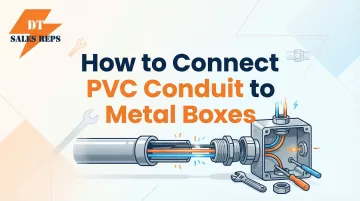
Thread the PVC male terminal adapter onto the prepared conduit end. This adapter has a smooth PVC socket on one end (which accepts the conduit) and male threads on the other end that pass through the knockout.
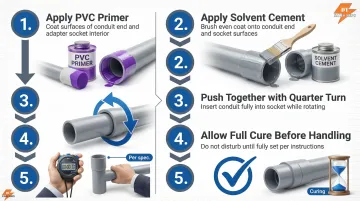
If using a socket-type adapter:
- Apply PVC primer to both the conduit end and adapter socket
- Apply solvent cement to both surfaces
- Push together with a quarter turn
- Hold for the manufacturer's recommended time
- Allow full cure time before handling
Step 4: Secure the Adapter to the Metal Box
Insert the threaded end of the adapter through the knockout from the outside. Thread a locknut onto the adapter from inside the box and tighten firmly by hand, then snug with pliers.
Tighten hand-tight, then add one-quarter turn with pliers. Stop there — over-torquing cracks the PVC adapter threads.
Install the insulating bushing over the threaded end inside the box, between the locknut and the wire entry point. NEC 300.4(G) requires protection for conductors at metal edges.
Note the 2023 code update: bushings must be installed before pulling conductors — not after.
Final verification:
- Adapter is centered in the knockout
- Locknut is seated flush against the interior box wall
- Conduit has no lateral movement
Key Factors That Affect a Secure, Code-Compliant Connection
The quality and long-term reliability of a PVC-to-metal box connection depends on controlling several specific variables. Failing to account for even one can result in a failed inspection or a genuine safety hazard. Four variables consistently determine whether an installation passes or gets flagged.
Fitting Compatibility and Trade Size Match
The PVC male terminal adapter must exactly match both the conduit's trade size and its schedule. Under NEMA TC-2 and UL 651 standards, Schedule 40 and Schedule 80 PVC conduits share identical outside diameters for equivalent trade sizes—the difference is wall thickness only.
An undersized or oversized adapter won't grip the conduit properly or fill the knockout cleanly, leaving gaps that expose conductors to moisture or physical damage.
Grounding Continuity at the Metal Box
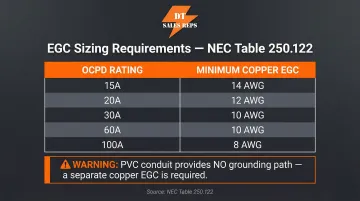
Because PVC conduit is non-conductive, it provides zero grounding continuity. The metal box relies entirely on a dedicated equipment grounding conductor (EGC) run inside the conduit.
NEC 250.118 lists acceptable equipment grounding methods—PVC conduit is explicitly excluded. NEC 352.60 requires a separate grounding conductor inside the PVC conduit where equipment grounding is needed.
A metal box without proper grounding creates a shock hazard. Inspectors will fail any installation that relies on PVC conduit alone to ground a metal enclosure.
EGC sizing: Use NEC Table 250.122 to size the EGC based on the overcurrent protective device (OCPD) rating:
| OCPD Rating | Minimum Copper EGC |
|---|---|
| 15A | 14 AWG |
| 20A | 12 AWG |
| 30A | 10 AWG |
| 60A | 10 AWG |
| 100A | 8 AWG |
Knockout Size and Conduit Fill
The knockout diameter must correspond to the conduit trade size. NEMA OS-1 and UL 514A govern actual knockout dimensions—not NEC Chapter 9, Table 1 (which addresses conduit fill percentages, not hole sizes).
Oversized knockouts leave gaps around the adapter that allow moisture ingress and fail weatherproof requirements. Overcrowded boxes create heat buildup and trigger code violations on inspection.
Locknut Torque
The locknut must provide a firm, rattle-free connection without cracking the PVC adapter's threaded section.
An under-tightened locknut allows the conduit to pull free under wire-pull tension or vibration. An over-tightened one can fracture the adapter near the threads, requiring adapter replacement and re-threading.
Common Mistakes When Connecting PVC Conduit to Metal Boxes
Avoid these three errors that commonly cause failed inspections and long-term connection problems:
- Applying solvent cement at the metal interface — PVC cement only bonds PVC-to-PVC. Using it between the adapter and metal box creates a messy, non-functional connection and makes disassembly harder. The actual fix is a correctly sized locknut, not cement.
- Skipping the insulating bushing — Omitting the bushing leaves sharp metal knockout edges in direct contact with conductor insulation. This is a code violation and creates insulation failure risk, particularly where wires are pulled after conduit is already installed.
- Using a standard PVC coupling instead of a terminal adapter — Couplings are designed for PVC-to-PVC joints and have no threads to engage the knockout. The result is an unsecured conduit that can pull away from the box under wire-pull tension or vibration.
Troubleshooting Common Connection Issues
Even with the correct parts, a few problems come up consistently during or after installation. Here's how to diagnose each one.
Conduit Pulls Away from the Metal Box After Installation
The locknut wasn't tightened adequately, or the wrong trade-size adapter was used — preventing the locknut from threading far enough to grip the box wall.
To diagnose:
- Remove the conduit end and inspect the adapter threads for damage
- Replace the adapter if threads are stripped; resize if the trade size is wrong
- Reinstall with proper locknut torque until the locknut bites firmly against the box interior
Water or Moisture Entering the Metal Box Through the Conduit Entry
Two situations cause this: an oversized knockout leaving a gap around the adapter, or an outdoor installation where no weatherproof fitting or conduit seal was used.
Start by confirming the adapter and knockout sizes match. For wet or outdoor locations, keep in mind that standard terminal adapters and locknuts are not inherently raintight. Depending on the installation environment, you'll need either listed neoprene sealing washers or a UL-listed raintight hub.
Grounding Continuity Test Fails at the Metal Box
The equipment grounding conductor (EGC) either wasn't pulled through the conduit or wasn't terminated at the metal box's grounding screw or busbar.
Verify all three of the following:
- A green or bare copper EGC is present inside the conduit
- The conductor is sized correctly per NEC Table 250.122
- The EGC is landed at the metal box grounding point
Conclusion
Connecting PVC conduit to a metal box is straightforward when the correct fitting—a PVC male terminal adapter with locknut and insulating bushing—is selected and installed properly. The key distinction from PVC-to-PVC joints is that solvent cement plays no role at the metal interface.
The most critical non-mechanical step is grounding: PVC conduit provides no grounding path, so a properly sized EGC inside the conduit is a code requirement under the NEC, protecting both people and equipment.
Getting the fittings right starts before installation. Correctly rated and sized PVC terminal adapters sourced through a reliable distributor — like DT Sales Reps, which supplies conduit and fittings to electrical contractors across the industry — reduce the risk of failed inspections and rework on the jobsite.
Frequently Asked Questions
Do I need a special adapter to connect PVC conduit to a metal box?
Yes, a PVC male terminal adapter (also called a terminal adapter or male adapter) is required. It has a PVC socket end that bonds to the conduit and a threaded end that passes through the knockout and is secured with a locknut. Standard PVC couplings do not work for this connection.
Does using PVC conduit with a metal box affect grounding?
Yes. PVC is non-conductive and provides no grounding continuity, so a dedicated equipment grounding conductor must be run inside the conduit and landed on the metal box's grounding point to meet NEC 250.118 requirements.
Can I use PVC solvent cement when connecting PVC conduit to a metal box?
PVC cement is used only at the PVC-to-PVC joint (conduit to adapter socket)—it is not applied between the adapter and the metal box. The metal connection is secured mechanically with a locknut.
What size knockout does PVC conduit require in a metal box?
The knockout must match the trade size of the PVC conduit being installed (e.g., ¾" conduit requires a ¾" knockout). Knockout sizes are standardized per NEMA OS-1 and UL 514A.
Is it code-compliant to run PVC conduit into a metal electrical box?
Fully NEC-compliant — provided fittings are UL 514B-listed for the application and the installation meets NEC Article 352 requirements for rigid PVC conduit.
Do I need a locknut when connecting PVC conduit to a metal box?
A locknut is required on the inside of the metal box to secure the threaded end of the PVC male adapter. Without it, the conduit is not mechanically secured to the box — a code violation and a physical hazard.